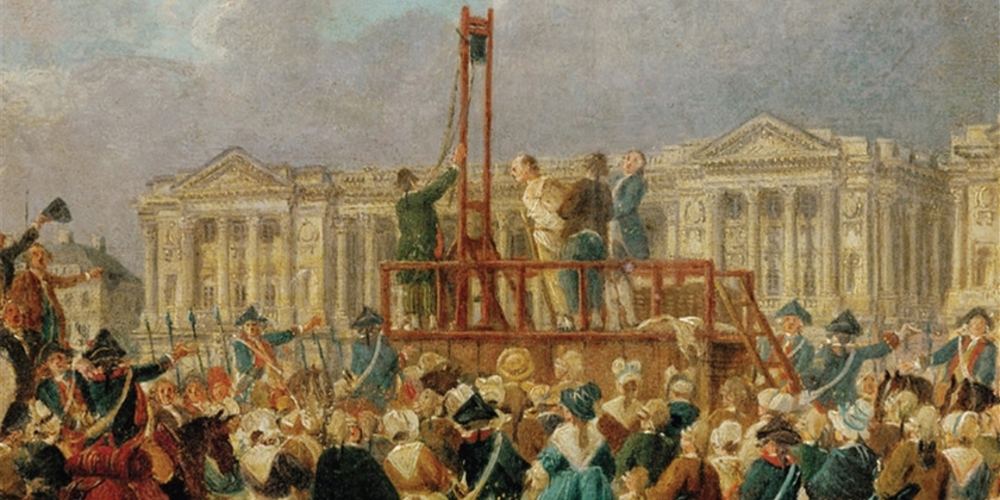
Now that Christmas Day has passed, I have put down my beloved copy of Charles Dickens’s A Christmas Carol and picked up his masterpiece, A Tale of Two Cities. As I have argued before, that novel’s opening sentence perfectly captures the contradictions of our time:
It was the best of times, it was the worst of times, it was the age of wisdom, it was the age of foolishness, it was the epoch of belief, it was the epoch of incredulity, it was the season of Light, it was the season of Darkness, it was the spring of hope, it was the winter of despair, we had everything before us, we had nothing before us, we were all going direct to Heaven, we were all going direct the other way — in short, the period was so far like the present period, that some of its noisiest authorities insisted on its being received, for good or for evil, in the superlative degree of comparison only.
And you thought that I struggled to locate a terminal period for some of my longest sentences! In Dickens’s defense, it is one hell of a sentence! It is also a sophisticated description of the tumultuous events that accompany transformative eras such as our own — what many have come to regard as a “Fourth Turning,” when crisis and social upheaval dominate life for a generation.
Will we be able to “Make America Great Again”? Will this be the beginning of a new American “Golden Age,” as President Trump suggests? Or will we soon endure economic collapse and war the likes of which none of us has ever seen? As 2024 comes to an end, it is fair to say that uncertainty is only accelerating and that the prospects for peace and prosperity are running neck and neck with their opposites.
We are surrounded by creature comforts that our relatives living during the First World War would have struggled to imagine. Flat-screen televisions with enough high-definition detail to transport us onto athletic fields of live sporting events or into realistic scenes of whatever shows we happen to be watching. Handheld computers that allow us to track down information and interact with strangers from all over the world. Online markets that link buyers and sellers who never would have found each other even twenty years ago. For most of human history, the wealthiest kings and queens never lived as luxuriously as many of the poorest people in the West live today.
Yet there is a darkness burbling beneath all this technological magic. Even before our televisions were “smart,” the programs on their screens provided manipulative actors the means to “program” what we believe. I refer not to the glitzy celebrities, but rather to those agents in boardrooms and committee rooms who use those celebrities to push messages we don’t always consciously see. Situational comedies have made us laugh for eighty years, but their product placements have subtly influenced what we buy. Their storylines have subtly influenced our opinions regarding politics, morality, and war. We turn on televisions to be entertained, but corporations and governments use television to shape our thoughts and keep us under their control. Mass propaganda does not work without our willingness to disengage our brains and let the “boob tube” do our thinking for us. There’s nothing “smart” about that.
These handheld computers that we call phones are similarly Janus-faced. On the one hand, I have felt fortunate to live during a time of intellectual nirvana, when no branch of knowledge lies beyond my reach. Esoteric subjects that once required me to seek out small collections in far-flung libraries are now instantly available in the palm of my hand. If knowledge is nourishment, then the rapid evolution of the internet combined with inexpensive mobile computers has given us an incomparably delectable feast.
On the other hand, we now see how those who manipulate us for a living will use the tantalizing smorgasbord of information at our fingertips to poison our minds and keep us in the cages they built for us long ago. For a while there, it seemed as if we had broken free from those cages. Governments’ monopolies over both mass communication and the availability of information appeared to have been shattered, as if Prometheus had stolen fire from the globalist gods and given it to the eight-billion-strong human rump that the infinitesimally small number of planetary “elites” prefer to keep in the dark.
Now that fire is slowly dying. Libraries and newspapers are retreating behind paywalls. Sources of information that conflict with governments’ preferred “narratives” are disappearing from corners of the internet. Government censors work with secretive “non-governmental” organizations to bankrupt independent news sites and criminalize dissent. Once-contrarian websites (such as the Drudge Report) have started toeing the Establishment line — as if they were quietly taken over by ideological enemies or their owners were threatened into submission. “Misinformation” and “disinformation” — words that meant little to Westerners two decades ago — have been elevated to national security bogeymen on par with nuclear weapons, so that governments can justify censorship on an industrial scale. We live both in a “Golden Age” of free speech and access to information and an unstable cauldron of viewpoint discrimination, intellectual suppression, “woke” bowdlerization, and State-sanctioned propaganda.

In this stomach-churning stew of technology-enabled propaganda and censorship, our favorite devices are also our jailers. Our “smart” phones and televisions spy on our conversations, monitor our movements, record our social interactions, and scrutinize our purchases. Our daily “selfies,” retinal and fingerprint security verifications, and health-tracking apps collect our biometric information while logging changes in our physical and psychological well-being. Technology companies and their government partners have complete access to our phone calls, text messages, emails, and social media histories. Our digital contacts provide intelligence agencies with a tidy list of our “known associates.” And these same devices that permit corporate and government spies to watch everything we do simultaneously allow those agents to bombard us with a constant stream of propaganda in the form of fake news (actual “disinformation” in government parlance).
Yet the best and worst features of modern technology merely distract us from a far more serious problem. For more than a century, the Federal Reserve System has printed paper money and constructed an unsustainable world of unfathomable debt. We cannot avoid the financial tribulation headed our way; we can only delay its arrival, just as Ponzi-scheming bankers and profligate politicians have done for decades.
In order to postpone economic collapse, the fraud-inducing Fed and its fraud-enabling partners in government have (1) placed downward pressure on wages by encouraging women to join the workforce, (2) decoupled from the gold standard, (3) imposed the petrodollar upon global markets to stimulate artificial dollar demand, (4) offshored entire industries to slave-labor nations, (5) regulated markets, (6) spent recklessly, (7) started wars, (8) used COVID lockdowns to contain inflation, (9) imposed “climate change” taxes, and (10) completely opened U.S. borders to illegal aliens willing to work for slave wages.
These policies were never about feminism, “free trade,” health, security, or multiculturalism. They were implemented to slow the catastrophic (and mathematically inevitable) inflation naturally resulting from a century of money-printing. Nevertheless, the U.S. dollar has lost 99% of its value since 1971. We have “fundamentally transformed” from a society in which a single breadwinner could earn enough to support a large family to a society in which two parents must work multiple jobs even for a small family to stay afloat.
As 2024 ends, we should be filled with determination and hope. But we have much to do if we are to survive the consequences of a century of government malice, predation, and foolishness.
Bypass Big Tech Censors

Starting the Day With a Scripture-Inspired Roast Helps Center Your Thoughts on Eternal Truths Amid Temporal Pressures
The world can seem chaotic, especially right after we wake up. Many believers start their mornings reaching for something familiar — a hot cup of coffee — yet end up settling for mediocre brews that do little more than deliver a caffeine jolt. The daily grind of life, with its endless distractions, news cycles, and responsibilities, can leave even the most faithful feeling spiritually parched alongside their physical fatigue. What if your morning ritual could do more than wake you up? What if it could ground you in truth, nourish your body with exceptional quality, and quietly advance a kingdom purpose at the same time?
That’s the promise — and the reality — behind Promised Grounds Coffee. This Christian-founded company doesn’t just roast beans; it approaches every step as an act of worship and discipleship. By selecting only the top 10% of specialty-grade beans, ethically sourced from dedicated farmers in Central and South America, and small-batch roasting them with reverence in Austin, Texas, Promised Grounds delivers what many describe as the best coffee available — never burnt, never bland, but rich with origin stories and layered flavors that honor God’s creation.
From the vibrant Psalm 27 Roast (a light, bright medium option) to the bold yet peaceful 2 Timothy 1:7 Decaf, each bag carries a Scripture verse that turns your daily pour into a gentle reminder of faith. And through their Ounce Per Ounce Promise, every ounce of coffee you enjoy provides an equal ounce of clean water to families in need via partnership with Filter of Hope — literally brewing hope for body and soul, one cup at a time.
The challenge for today’s Christians runs deeper than finding a decent cup. In an age of convenience-driven consumerism, it’s easy to support companies that dilute values or remain silent on matters of faith. Many believers want their everyday choices — from what they drink to how they spend — to reflect discipleship rather than just convenience. Promised Grounds solves this by weaving Christian excellence into the entire process: beans nurtured with prayerful stewardship by farming families, roasted as an offering rather than a commodity, and packaged with Bible verses to encourage a mindset of gratitude and purpose from the first sip. Reviewers consistently praise the smooth, rich profiles — whether enjoyed black in a drip maker, iced on a warm day, or shared in fellowship — noting how the quality stands toe-to-toe with premium secular brands while delivering something far more meaningful.
This integration of faith and flavor addresses a real need in Christian households and ministries. Busy parents, church leaders, and remote workers alike report that starting the day with a Scripture-inspired roast helps center their thoughts on eternal truths amid temporal pressures. The coffee’s exceptional character — bright citrus notes in lighter roasts or deep chocolate undertones in bolder ones — comes from meticulous selection and careful roasting that respects the bean’s natural gifts rather than masking them. It’s the kind of coffee that elevates a simple quiet time, fuels productive workdays, or sparks meaningful conversations when shared at Bible studies or outreach events. And because it’s ethically sourced with integrity, every purchase supports sustainable livelihoods for farmers who treat their crops like family harvests.
For those leading churches or small groups, the impact multiplies. Promised Grounds offers bundles and options perfect for hospitality ministries, turning ordinary coffee service into an opportunity to point people toward the living water of Christ. Imagine greeting visitors with a warm cup whose very bag carries God’s Word — a subtle yet powerful witness that aligns with the Great Commission. The company’s Texas roots and commitment to “brewing hope” resonate especially with believers who value American enterprise paired with global compassion.
Of course, quality alone isn’t enough if the experience feels out of reach. Promised Grounds keeps it accessible with practical perks like free shipping on orders over $40, sample sets for discovering favorites, and thoughtful add-ons such as faith-themed mugs. Whether you prefer whole beans for fresh grinding, grounds for convenience, or even bulk options for larger households and ministries, the result is consistently superior coffee that makes discipleship feel integrated rather than added on.
As you consider how to align even the smallest habits with your walk with God, Promised Grounds Coffee stands out as a refreshing solution. It tackles the dual problems of subpar daily sustenance and disconnected consumption by offering a product that genuinely excels in taste while advancing a mission of clean water, farmer dignity, and scriptural encouragement. Believers who make the switch often describe it as more than a beverage upgrade — it becomes part of their rhythm of gratitude, a daily invitation to remember that every good gift comes from above.
If you’re ready to transform your mornings (and perhaps your church gatherings) with coffee that honors both exceptional craftsmanship and Christian values, I encourage you to explore what Promised Grounds has to offer. One sip at a time, you’ll be nourishing your body, refreshing your spirit, and participating in something far greater — all while enjoying what truly is among the best coffee available.