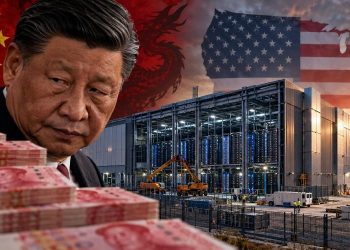
(Mises)—The European political and financial elite knows that the war in Ukraine is lost but wants to use it as an opportunity to reach strategic independence from the United States. As the future chancellor of Germany Friedrich Merz said right after his electoral win on Feb 23: “It will be an absolute priority for me to strengthen Europe as soon as possible so much that it gradually really achieves independence from the United States.”
Such strategic independence needs money and investment—a lot of it—not only to boost defense but much else, like energy and innovation; areas in which Europe is lagging behind the US and China. In order to have the pretext to implement this spending plan, the idea among the EU elite is to make sure that the war in Ukraine does not end too quickly. That way the conflict can be used to justify artificially injecting much needed money into the moribund EU economies.
First, there was a question of providing €20 billion euros of additional military support for Ukraine and that the EU self-imposed fiscal rules to be loosened using the existing “escape clause” in the event of “exceptional” circumstances, such as the bogus “defense of Ukraine” excuse. As Bloomberg stated, “under this plan, EU nations would be exempt from debt and deficit limits when financing military expenditures. This marks a fundamental shift in EU financial policy, as such exemptions have previously been impossible under EU rules.”
Indeed, the EU elite does not want to follow the arbitrary EU fiscal rules: for Paris, the 3 percent limit of budget deficit to GDP is politically painful, and for Berlin, the limit of max 60 percent of GDP in terms of federal public borrowing seems like an artificial constraint.
Then there was a talk of a €700 billion euro defense package. Newsweek stated that: “Baerbock said the package could be worth some 700 billion euros ($732 billion).” French President Emmanuel Macron also confirmed this on March 2, 2025. “We will give a mandate to the European Commission to define our capacity needs for a common defense,” Macron said in an interview published in several French newspapers. “This massive funding will probably reach hundreds of billions of euros.”
The official slogan of “help Ukraine defend itself” will give the EU political and financial elite an excuse to turn on the spigots of the European Central Bank at full thrust again; to shower the entire European economy with “free” money, and shore up its fragile economies, like it did after the euro crisis of 2011, with the enormous covid recovery fund in 2021, as well as with the Green New Deal.
Doping EU Economies with Joint EU Bonds
This time, the idea seems to be to use joint EU bonds. Reuters writes: “The bigger amounts will have to come from some type of centralized funding, because most budgets in Europe are relatively stretched, particularly in Italy and France.” As was stated in the infamous Draghi Report from Sept 2024: “the EU should move towards regular issuance of common safe assets to enable joint investment projects among Member States and to help integrate capital markets.” Therefore, “common issuance should over time produce a deeper and more liquid market in EU bonds.”
Joint EU bonds are essentially bond issuances against the whole euro economy and would thus entail a low risk and a lower interest rate than country level EU bonds. This is perceived as necessary in order for the EU to hold its own in competition with the US and China that already have unified capital markets, as a speech Draghi gave to the EU Commission last year made clear.

There are three main sources of war financing: printing money, increasing taxes, and borrowing. Making available “hundreds of billions” for the EU would likely be based on debt issued from joint EU bonds. Bloomberg noted that, if the spending were funded with tax increases, or cuts in other areas, that could wipe out any positive impact—or worse. Any immediate spending on the military would not help Europe because it would be mostly spent buying US weapons.
Therefore, what the EU elite has in mind now is likely to put in place what F. Merz said; a strategic independence from the US through a huge investment by joint EU bonds, released and used over the long term in order to slowly build up Europe’s industry, not only in the defense sector but also in other sectors.
The EU Debt Plan is About Centralizing Financial Control
In a sense, this would-be debt plan is just the European Union emulating the United States playbook of using war for crony capitalist benefits, finally “understanding” how to cynically exploit the Ukraine war, just as the US has been doing since 2022 by feeding its military-industrial complex. But, in order for this to happen, the war must not end too soon for the European elite, which is why efforts are made in order to—outrageously—spoil any US peace plans and get the war to continue for now.
This plan is the typical Keynesian militarist spending plan that European states were up to already from WWI and onwards—and not only the fascists and the Nazis, as John T. Flynn’s showed in his essential book, As We Go Marching.
The consequences over time of this public spending spree will be as disastrous for Europe as they are obvious, of course, for students of the Austrian School of economics. It will, as always, lead to price inflation and devalue the euro currency, it will inflate bubbles, it will distort EU economies, it will lead to malinvestments, and—last but not least—it will leave small European businesses, the backbone of Europe’s economies, hanging out to dry. It will just kick the can down the road and allow the EU government to postpone dealing with their real structural problems, both economic and political. This is particularly true for France.
But all this is beside the point for the European elite, because from their point of view this spending will artificially boost GDP in the many member states, it will create qualified jobs with the defense and energy sectors all over Europe and thus absorb some of the systemic unemployment which is a product of decades of heavy state interventionism. It will allow further centralization and harmonization of European economies to the benefit of power centralization in Brussels, as it will instead drive for common defense platforms instead of the fragmented patchwork of defense suppliers that exist in Europe today. As usual, the interests of the ruling minority diverge from the interests of the disorganized and ruled majority.
Finally, it will make current EU politicians more popular than now (which, admittedly, isn’t hard), and it will benefit their careers and most likely their personal wealth as well through all the kickbacks that they will get. The President of the European Commission, Ursula von der Leyen and many other EU bureaucratic parasites already know this type of “business” well.
This, at least, seems to be the plan. There should not be much political opposition to it, since it would be political suicide to oppose a plan that “not only will make Europe great again (MEGA), but also safer (from Russia)!” The confirmed victory of Merz’s CDU in Germany already made the potential political opposition from the AfD lighter.
This is yet another case which shows that Western publics—not only in Europe but also in the US—need to understand better that money creation, whether through debt or otherwise, and artificially pumping this money into the economy will not be to their benefit. The negligeable benefits to the majority of such policies can never justify their real objective of sustaining massive bureaucratic states and increasing their control over society. It is therefore as urgent as ever to continue to spread the knowledge and wisdom of Austrian economics.
Bypass Big Tech Censors

Starting the Day With a Scripture-Inspired Roast Helps Center Your Thoughts on Eternal Truths Amid Temporal Pressures
The world can seem chaotic, especially right after we wake up. Many believers start their mornings reaching for something familiar — a hot cup of coffee — yet end up settling for mediocre brews that do little more than deliver a caffeine jolt. The daily grind of life, with its endless distractions, news cycles, and responsibilities, can leave even the most faithful feeling spiritually parched alongside their physical fatigue. What if your morning ritual could do more than wake you up? What if it could ground you in truth, nourish your body with exceptional quality, and quietly advance a kingdom purpose at the same time?
That’s the promise — and the reality — behind Promised Grounds Coffee. This Christian-founded company doesn’t just roast beans; it approaches every step as an act of worship and discipleship. By selecting only the top 10% of specialty-grade beans, ethically sourced from dedicated farmers in Central and South America, and small-batch roasting them with reverence in Austin, Texas, Promised Grounds delivers what many describe as the best coffee available — never burnt, never bland, but rich with origin stories and layered flavors that honor God’s creation.
From the vibrant Psalm 27 Roast (a light, bright medium option) to the bold yet peaceful 2 Timothy 1:7 Decaf, each bag carries a Scripture verse that turns your daily pour into a gentle reminder of faith. And through their Ounce Per Ounce Promise, every ounce of coffee you enjoy provides an equal ounce of clean water to families in need via partnership with Filter of Hope — literally brewing hope for body and soul, one cup at a time.
The challenge for today’s Christians runs deeper than finding a decent cup. In an age of convenience-driven consumerism, it’s easy to support companies that dilute values or remain silent on matters of faith. Many believers want their everyday choices — from what they drink to how they spend — to reflect discipleship rather than just convenience. Promised Grounds solves this by weaving Christian excellence into the entire process: beans nurtured with prayerful stewardship by farming families, roasted as an offering rather than a commodity, and packaged with Bible verses to encourage a mindset of gratitude and purpose from the first sip. Reviewers consistently praise the smooth, rich profiles — whether enjoyed black in a drip maker, iced on a warm day, or shared in fellowship — noting how the quality stands toe-to-toe with premium secular brands while delivering something far more meaningful.
This integration of faith and flavor addresses a real need in Christian households and ministries. Busy parents, church leaders, and remote workers alike report that starting the day with a Scripture-inspired roast helps center their thoughts on eternal truths amid temporal pressures. The coffee’s exceptional character — bright citrus notes in lighter roasts or deep chocolate undertones in bolder ones — comes from meticulous selection and careful roasting that respects the bean’s natural gifts rather than masking them. It’s the kind of coffee that elevates a simple quiet time, fuels productive workdays, or sparks meaningful conversations when shared at Bible studies or outreach events. And because it’s ethically sourced with integrity, every purchase supports sustainable livelihoods for farmers who treat their crops like family harvests.
For those leading churches or small groups, the impact multiplies. Promised Grounds offers bundles and options perfect for hospitality ministries, turning ordinary coffee service into an opportunity to point people toward the living water of Christ. Imagine greeting visitors with a warm cup whose very bag carries God’s Word — a subtle yet powerful witness that aligns with the Great Commission. The company’s Texas roots and commitment to “brewing hope” resonate especially with believers who value American enterprise paired with global compassion.
Of course, quality alone isn’t enough if the experience feels out of reach. Promised Grounds keeps it accessible with practical perks like free shipping on orders over $40, sample sets for discovering favorites, and thoughtful add-ons such as faith-themed mugs. Whether you prefer whole beans for fresh grinding, grounds for convenience, or even bulk options for larger households and ministries, the result is consistently superior coffee that makes discipleship feel integrated rather than added on.
As you consider how to align even the smallest habits with your walk with God, Promised Grounds Coffee stands out as a refreshing solution. It tackles the dual problems of subpar daily sustenance and disconnected consumption by offering a product that genuinely excels in taste while advancing a mission of clean water, farmer dignity, and scriptural encouragement. Believers who make the switch often describe it as more than a beverage upgrade — it becomes part of their rhythm of gratitude, a daily invitation to remember that every good gift comes from above.
If you’re ready to transform your mornings (and perhaps your church gatherings) with coffee that honors both exceptional craftsmanship and Christian values, I encourage you to explore what Promised Grounds has to offer. One sip at a time, you’ll be nourishing your body, refreshing your spirit, and participating in something far greater — all while enjoying what truly is among the best coffee available.