Important note: The last thing we need is fearmongering since that is what the Powers and Principalities want. I am posting this article to inform, not to make anyone go out and grab a bunch of masks. You can and should hear my full take on this theory on YouTube. With that said, here’s the article…
Three people are dead, one is in intensive care in Johannesburg, and a Swiss man is now isolated in a Zurich hospital after stepping off a ship that visited some of the most remote corners of the planet. The MV Hondius — a Dutch-flagged Oceanwide Expeditions vessel — sailed from Ushuaia, Argentina on April 1, threaded its way through Antarctica, South Georgia, Tristan da Cunha, Saint Helena, and Ascension, and is now bound for Spain’s Canary Islands after Cape Verde refused it port.
The pathogen onboard is hantavirus, specifically the Andes strain. Of every hantavirus strain on earth, that is the only one known to transmit between human beings.
The official line, courtesy of the World Health Organization, is that there is “no need for panic or travel restrictions.” Hans Kluge, WHO’s regional director for Europe, said so himself. The official theory is that a Dutch couple picked the virus up on a bird-watching tour in Ushuaia before boarding, and that the rest is just rare, unfortunate spread.
Anonymous Argentine officials whispered that explanation to the Associated Press. Tierra del Fuego province, where Ushuaia sits, has never recorded a hantavirus case in its history. The story, in other words, has the texture of a press release.
And maybe that’s all it is. Sometimes a tragedy at sea is just a tragedy at sea. But there are reasons to look twice at this one.
The Eight-Week Fuse
Hantavirus has one feature that ought to alarm anyone paying attention to how this story will unfold over the next two months. Symptoms can take anywhere from one to eight weeks to appear after exposure. The Centers for Disease Control, the Mayo Clinic, the American Lung Association, Harvard Health, and the WHO itself all confirm the same window.
That means roughly 25 passengers who disembarked by April 24, plus everyone they have passed through customs alongside, plus everyone in their household, plus everyone they sat next to on a flight home, are walking around right now in a stealth incubation period that will not resolve until late June.
Switzerland already has its first confirmed case. He went home, lived his life, and only later figured out something was wrong. How many more are out there? Nobody knows. Nobody can know. That is the structural feature of this pathogen: by the time the symptoms arrive, the geography has already scattered.

If a malign actor — a globalist cabal, a rogue lab, the powers and principalities the Apostle Paul warned about — wanted to design a curtain-raiser for a manufactured pandemic, they would want exactly this. A long incubation window. Multinational passengers. A Petri dish vessel that crosses jurisdictional boundaries. A pathogen rare enough that nobody has acquired immunity, exotic enough to capture global headlines, but deadly enough to drive the fear that funds the surveillance state.
The Andes Coincidence
Hantavirus has been on the rodent-borne radar since the Four Corners outbreak of 1993. There are dozens of strains. Almost none of them spread between people. The one strain that does — Andes — is the one that ended up on the Hondius.
It is also, not coincidentally, the strain that virologists have been studying for decades precisely because of its anomalous human-to-human capacity. If you were assembling a wish-list pathogen for a respiratory tabletop exercise, the Andes hantavirus would sit near the top of the column. Rare. Lethal. Lung-targeting. Capable of limited spread between hosts. Almost no public familiarity, which means almost no public skepticism when the experts arrive to explain it.
The WHO is already explaining it. The Pan American Health Organization is coordinating with the Argentine Ministry of Health. The Spanish Ministry of Health is fielding the patients. Cape Verde refused the ship; Tenerife will receive it. International protocols are humming.
The architecture of pandemic governance, after years of being rejected by sovereign nations and ridiculed by skeptical citizens, is suddenly running a real-world drill in the headlines, and the response is being framed not as a story about three dead tourists but as a story about international coordination working.
A Treaty That Just Happened to Be Ready
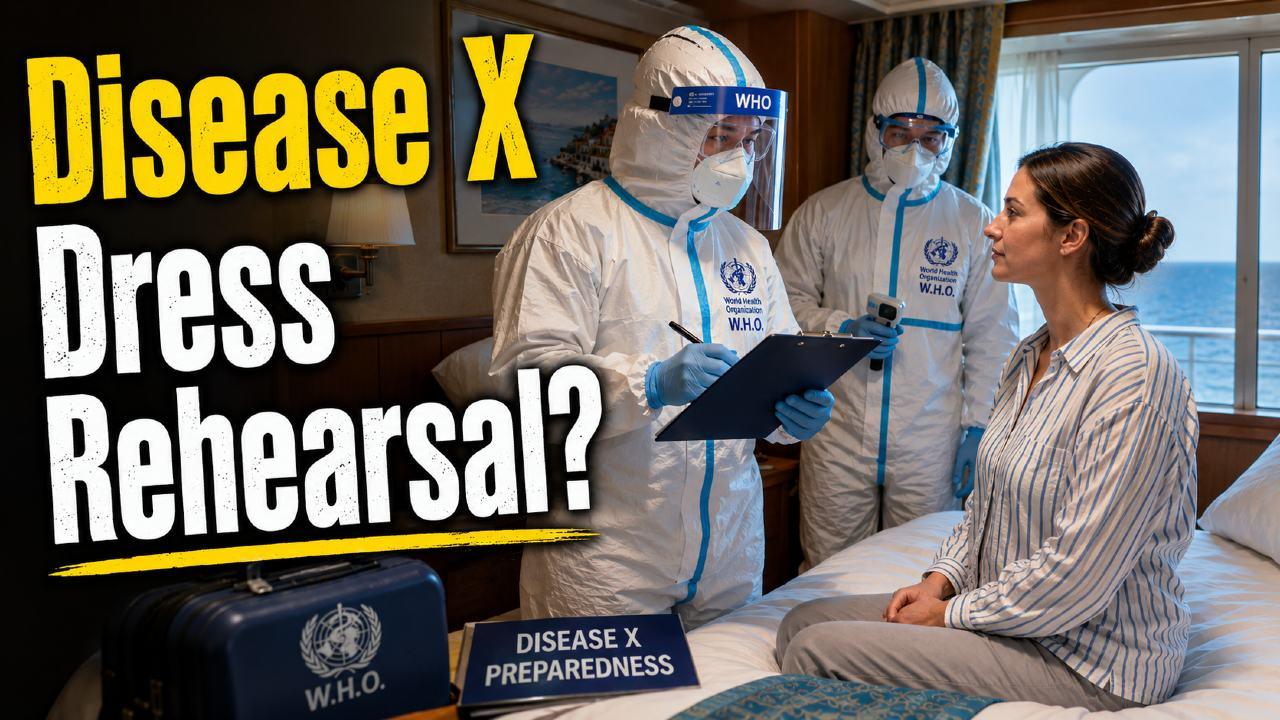
Here is the timing that ought to make the hair stand up on the back of any honest observer’s neck. In May of 2025 — almost exactly one year ago — the World Health Assembly adopted the long-disputed Pandemic Agreement. Tedros Adhanom Ghebreyesus, the WHO’s director-general, has been talking about “Disease X” since Davos 2024, when he told the World Economic Forum that the next pandemic was “a matter of when not if” and that nations needed to surrender their fragmented responses to a unified global framework.
The treaty was the framework. The framework was finalized. And almost on cue, here is the first multi-country outbreak event of the post-treaty era, with WHO running point.
None of this proves anything. A skeptic of the conspiracy framing would say that Disease X is a generic preparedness term, that hantavirus has surfaced in clusters before, that the Hondius is an unlucky ship and not a controlled experiment.
Fair enough. But “conspiracy theorists” have been told for five years now that the official story is always the only story, that questioning the timing of convenient crises is the mark of a deranged mind. We were told that in 2020. We were told that about lab leaks. We were told that about every single thing that turned out to be true.
Watch the Ship, Watch the Shadows
The Hondius will dock in Tenerife in a few days. Passengers will disperse. Some will get sick. The headlines will follow. The WHO will hold press conferences, the treaty machinery will be praised, and somewhere in a closed conference room the planners will take notes on what worked and what did not. The dress rehearsal — if that is what this is — will produce a polished script for whatever comes next.
Ephesians 6:12 reminds us that we wrestle not against flesh and blood, but against principalities, against powers, against the rulers of the darkness of this world, against spiritual wickedness in high places. The verse does not require believing in any particular conspiracy. It does, however, require believing that the visible actors are not the only ones in the room. The Hondius is one ship. The wider stage on which it sails is bigger, older, and considerably less benign than the WHO press releases will ever admit.
Three people are dead. 25 are out and about. Roughly 150 are soon to be scattered across continents on an eight-week clock. The treaty is signed. The script is written. The only question left is whether the audience is paying attention.

Bypass Big Tech Censors
Starting the Day With a Scripture-Inspired Roast Helps Center Your Thoughts on Eternal Truths Amid Temporal Pressures
The world can seem chaotic, especially right after we wake up. Many believers start their mornings reaching for something familiar — a hot cup of coffee — yet end up settling for mediocre brews that do little more than deliver a caffeine jolt. The daily grind of life, with its endless distractions, news cycles, and responsibilities, can leave even the most faithful feeling spiritually parched alongside their physical fatigue. What if your morning ritual could do more than wake you up? What if it could ground you in truth, nourish your body with exceptional quality, and quietly advance a kingdom purpose at the same time?
That’s the promise — and the reality — behind Promised Grounds Coffee. This Christian-founded company doesn’t just roast beans; it approaches every step as an act of worship and discipleship. By selecting only the top 10% of specialty-grade beans, ethically sourced from dedicated farmers in Central and South America, and small-batch roasting them with reverence in Austin, Texas, Promised Grounds delivers what many describe as the best coffee available — never burnt, never bland, but rich with origin stories and layered flavors that honor God’s creation.
From the vibrant Psalm 27 Roast (a light, bright medium option) to the bold yet peaceful 2 Timothy 1:7 Decaf, each bag carries a Scripture verse that turns your daily pour into a gentle reminder of faith. And through their Ounce Per Ounce Promise, every ounce of coffee you enjoy provides an equal ounce of clean water to families in need via partnership with Filter of Hope — literally brewing hope for body and soul, one cup at a time.
The challenge for today’s Christians runs deeper than finding a decent cup. In an age of convenience-driven consumerism, it’s easy to support companies that dilute values or remain silent on matters of faith. Many believers want their everyday choices — from what they drink to how they spend — to reflect discipleship rather than just convenience. Promised Grounds solves this by weaving Christian excellence into the entire process: beans nurtured with prayerful stewardship by farming families, roasted as an offering rather than a commodity, and packaged with Bible verses to encourage a mindset of gratitude and purpose from the first sip. Reviewers consistently praise the smooth, rich profiles — whether enjoyed black in a drip maker, iced on a warm day, or shared in fellowship — noting how the quality stands toe-to-toe with premium secular brands while delivering something far more meaningful.
This integration of faith and flavor addresses a real need in Christian households and ministries. Busy parents, church leaders, and remote workers alike report that starting the day with a Scripture-inspired roast helps center their thoughts on eternal truths amid temporal pressures. The coffee’s exceptional character — bright citrus notes in lighter roasts or deep chocolate undertones in bolder ones — comes from meticulous selection and careful roasting that respects the bean’s natural gifts rather than masking them. It’s the kind of coffee that elevates a simple quiet time, fuels productive workdays, or sparks meaningful conversations when shared at Bible studies or outreach events. And because it’s ethically sourced with integrity, every purchase supports sustainable livelihoods for farmers who treat their crops like family harvests.
For those leading churches or small groups, the impact multiplies. Promised Grounds offers bundles and options perfect for hospitality ministries, turning ordinary coffee service into an opportunity to point people toward the living water of Christ. Imagine greeting visitors with a warm cup whose very bag carries God’s Word — a subtle yet powerful witness that aligns with the Great Commission. The company’s Texas roots and commitment to “brewing hope” resonate especially with believers who value American enterprise paired with global compassion.
Of course, quality alone isn’t enough if the experience feels out of reach. Promised Grounds keeps it accessible with practical perks like free shipping on orders over $40, sample sets for discovering favorites, and thoughtful add-ons such as faith-themed mugs. Whether you prefer whole beans for fresh grinding, grounds for convenience, or even bulk options for larger households and ministries, the result is consistently superior coffee that makes discipleship feel integrated rather than added on.
As you consider how to align even the smallest habits with your walk with God, Promised Grounds Coffee stands out as a refreshing solution. It tackles the dual problems of subpar daily sustenance and disconnected consumption by offering a product that genuinely excels in taste while advancing a mission of clean water, farmer dignity, and scriptural encouragement. Believers who make the switch often describe it as more than a beverage upgrade — it becomes part of their rhythm of gratitude, a daily invitation to remember that every good gift comes from above.
If you’re ready to transform your mornings (and perhaps your church gatherings) with coffee that honors both exceptional craftsmanship and Christian values, I encourage you to explore what Promised Grounds has to offer. One sip at a time, you’ll be nourishing your body, refreshing your spirit, and participating in something far greater — all while enjoying what truly is among the best coffee available.