(Alt-Market)—In the aftermath of the Bolshevik Revolution and the takeover of Russia in 1917 (largely funded by international elites), the new communist regime sought to implement what I would call “propaganda saturation” – An avalanche of policies designed to secure the red army’s political power by manufacturing false consensus.
It should be noted that, even at the peak of the Bolshevik movement’s influence, the reds only represented around 23% of the total Russian population and were never a majority. However, they had substantial monetary backing from overseas (read Antony Sutton’s extensive study titled “Wall Street And The Bolshevik Revolution). Think of this as an “NGO funded rebellion”, the kind of thing we are witnessing in America today with militant woke activists.
It was this international backing that gave the communists the boost they needed to take physical control of the government. But what they really needed was control over the general populace. One tactic they relied on in the early stages of the takeover was the use of a “Red Calendar”. If this phrase is unfamiliar to you, you’re not alone. Most people have never heard of it.
The Red Calendar was a propaganda program designed to eliminate and replace existing Russian holidays and religious observances with new, secular holidays. Foremost on the agenda for the Bolsheviks was the erasure of Christianity, which they viewed as a dangerous competing ideological influence that could one day undermine the government’s authority.
If the population’s first loyalty is to God, then the government and the party will always be in second place. This was unacceptable.
The Red Calendar established a series of special Marxist holidays revolving around labor movements and the revolution. The soviets would later declare special month-long celebrations of certain ideals, such as the “month of solidarity” or the “month of friendship.”
In short, the Red Calendar was a deliberate ideological tool: Old holidays weren’t always formally “banned” everywhere at once, but they were systematically deprioritized, persecuted, or culturally overwritten in favor of new communist ones.
Not to be outdone, the National Socialists (Nazis) in Germany and Italy also engaged in projects similar to the Red Calendar. This is just one of the MANY parallels between the Soviet Marxists and the Third Reich (Hitler consistently admitted that the concept of National Socialism was rooted in Marxism).

The Nazis targeted Christian holidays, but instead of relying on atheist or secular propaganda models, they used pagan alternatives. Christmas, for example, was changed to “Yule” or the “Winter Solstice” and the role of Jesus was systematically repressed or removed.
For the leftists who claim that the Nazi’s were pro-Christianity, sorry, but you are wrong yet again. Hitler despised Christianity in his private life and viewed it as a religion “for weaklings”. He spoke often about how he wished that the German people had a more militant religious tradition, similar to Islam.
In his postwar memoir, Nazi architect Albert Speer recalled Hitler complaining about Germany’s “wrong religion”. In secret, the Third Reich sought to establish a pagan religion which they felt was more aggressive:
“You see, it’s been our misfortune to have the wrong religion. Why didn’t we have the religion of the Japanese, who regard sacrifice for the Fatherland as the highest good? The Mohammedan religion too would have been much more compatible to us than Christianity. Why did it have to be Christianity with its meekness and flabbiness?” – Adolph Hitler
The point is, socialists, whether nationalist or globalist, always seek to co-opt the existing culture of the countries they want to dominate. It’s one of the first things they do when they take over and the invasion is tailor made to subvert the specific culture being targeted. For the US, this looks less like a “workers revolution” and more like a coordinated insurgency of asylum patients against the traditional moral order.
The “gay rights” movement has long been at the forefront of this sabotage project, supported from behind the curtain by NGO’s like the Ford Foundation and communist groups like the Mattachine Society in the 1950s under Harry Hay. Once again, Joseph McCarthy was right.
Their propaganda tactics are relatively unknown to the average American because they simply are not mentioned in public schooling or college academia. But, in researching the history of Red Calendar methods you might find yourself recognizing a familiar pattern.
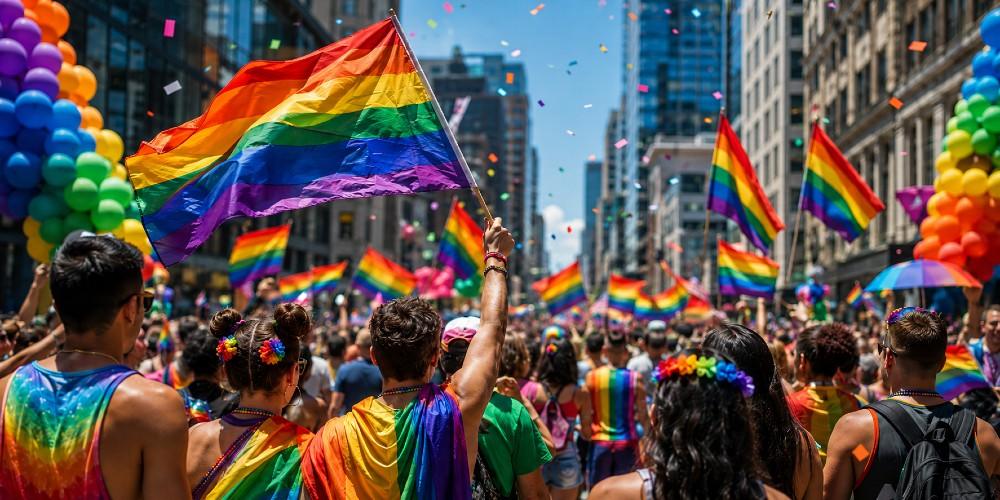
Well, it’s the first week of June once again and in recent years, for the vast majority of Americans, the month of June has brought with it a sense of overwhelming exhaustion. A WHOLE MONTH officially recognized by the government as a celebration of “LGBT Pride”. And yes, Pride Month is in every way an attempt by the far-left to bring back the communist Red Calendar.
Pride Month was first recognized by the federal government in 1999 under Bill Clinton (Mr. Lolita Express). It was expanded on by Barack Obama in 2009 to include transsexuals and Joe Biden flooded Pride programs with federal cash through USAID in 2021. He even went so far as to hold a pride celebration on the White House lawn which included guys with tits running around topless.
I can recall the national attitude towards gay people in 1999 was extremely accommodating. We were all indifferent and no one cared if someone was gay as long as they kept it away from children. Whatever people did privately was their business.
Zoomers like to pretend as if their mediocre activist movements are “changing the world” and bringing equality to minority groups, but Gen X already finished that job decades ago. In fact, one of the most popular shows on TV in 2003 was called “Queer Eye For The Straight Guy”, which featured a team of flaming gay dudes prancing around and taking straight guys on shopping sprees so that they would look less unkempt (and less masculine).
This was not an era of discrimination. Zoomer activism doesn’t solve problems, it creates problems.

The opposition started when the gay community, or whatever you want to call it, became the “LGBT” community. The opposition started when they became a political cult. Being gay suddenly meant joining a militant wing of the wider woke invasion into our social and governmental institutions. This is when “Pride” mutated into a monstrous blob; spreading beyond localized gatherings in liberal cities and turning into a national astroturf movement which everyone was forced to endure every summer.
ESG funding rained down on LGBT organizations through corporations and NGOs from 2015 onward. Not long after, Pride was everywhere. In our movies, in our TV shows, in our video games, in our comic books, in our sports, in our commercials, it was even on our food as companies slapped gay flags and activist mantras like “Love Is Love” on everything from candies to iced tea.
This was clearly a strategic effort hijack the cultural driver’s seat in the US. But the end, the inevitable end, was set in motion when Pride was injected into the public school system by far-left teachers unions. The agenda to indoctrinate children with transgender ideology and gay sexuality sealed the fate of “Pride Month.”
When the activists went after people’s kids, that’s when the greater majority of Americans started to realize that maybe, just maybe, the conservative “conspiracy theorists” of the early 2000s might have been right about a few things. Maybe, LGBT is not about equal rights? Maybe it’s about predatory politics, social control and the normalization of degeneracy?
Today, pride has imploded. Corporate sponsors have dried up along with ESG funding. The shutdown of USAID by the Trump Administration was integral to the death of LGBT Red Calendar celebrations because these groups relied heavily on government money to make organized events possible. As the money disappears, the real LGBT movement is barely noticeable. And, that’s the way it should be.
Anyone who makes their sexual orientation the very center of their identity is mentally ill, and no functional society should promote or celebrate mental illness. An even greater concern, though, is the exploitation of gay “victimhood” as a means to push socialism/communism/globalism.

It’s no coincidence that LGBT activism comes as a package deal with every globalist scam imaginable. To be “gay” these days means you are expected to applaud the deconstruction of the west, the death of free markets, the rise of climate change laws, the normalization of veganism, the end of freedom of speech (for everyone except communists), the systematic destruction of religion, etc.
There are gay people out their who don’t subscribe to any of these things, but the majority of them do, in many cases because they feel they are required to in order to fit in with the movement. It’s not enough to be gay, they have to be revolutionaries.
And this is why public support for gay issues is in decline in the US. This is why Pride Month was barely a blip on the gaydar in 2025 and it’s even less visible in 2026. By whoring out their community to the machinations of communists and globalists, gays really screwed themselves. Now, far less people are trusting.
Pride Month is, by itself, a kind of egomaniacal display of performative narcissism. That is to say, pride is not something to be proud of. Accomplishment is something to be proud of…but being gay is not an accomplishment. Many Americans now see Pride Month as nothing more than an act of self worship.
The pendulum is swinging back hard and I think the “persecution” the LGBT movement pretended to suffer from ten years ago might very will hit them hard in real life in the next few years. It was probably not the best idea to reanimate the communist Red Calendar or declare gays as idols to be worshiped for their “virtue”. The backlash is deserved.
If you would like to support the work that Alt-Market does while also receiving content on advanced tactics for defeating the globalist agenda, subscribe to our exclusive newsletter The Wild Bunch Dispatch. Learn more about it HERE.

Bypass Big Tech Censors
Starting the Day With a Scripture-Inspired Roast Helps Center Your Thoughts on Eternal Truths Amid Temporal Pressures
The world can seem chaotic, especially right after we wake up. Many believers start their mornings reaching for something familiar — a hot cup of coffee — yet end up settling for mediocre brews that do little more than deliver a caffeine jolt. The daily grind of life, with its endless distractions, news cycles, and responsibilities, can leave even the most faithful feeling spiritually parched alongside their physical fatigue. What if your morning ritual could do more than wake you up? What if it could ground you in truth, nourish your body with exceptional quality, and quietly advance a kingdom purpose at the same time?
That’s the promise — and the reality — behind Promised Grounds Coffee. This Christian-founded company doesn’t just roast beans; it approaches every step as an act of worship and discipleship. By selecting only the top 10% of specialty-grade beans, ethically sourced from dedicated farmers in Central and South America, and small-batch roasting them with reverence in Austin, Texas, Promised Grounds delivers what many describe as the best coffee available — never burnt, never bland, but rich with origin stories and layered flavors that honor God’s creation.
From the vibrant Psalm 27 Roast (a light, bright medium option) to the bold yet peaceful 2 Timothy 1:7 Decaf, each bag carries a Scripture verse that turns your daily pour into a gentle reminder of faith. And through their Ounce Per Ounce Promise, every ounce of coffee you enjoy provides an equal ounce of clean water to families in need via partnership with Filter of Hope — literally brewing hope for body and soul, one cup at a time.
The challenge for today’s Christians runs deeper than finding a decent cup. In an age of convenience-driven consumerism, it’s easy to support companies that dilute values or remain silent on matters of faith. Many believers want their everyday choices — from what they drink to how they spend — to reflect discipleship rather than just convenience. Promised Grounds solves this by weaving Christian excellence into the entire process: beans nurtured with prayerful stewardship by farming families, roasted as an offering rather than a commodity, and packaged with Bible verses to encourage a mindset of gratitude and purpose from the first sip. Reviewers consistently praise the smooth, rich profiles — whether enjoyed black in a drip maker, iced on a warm day, or shared in fellowship — noting how the quality stands toe-to-toe with premium secular brands while delivering something far more meaningful.
This integration of faith and flavor addresses a real need in Christian households and ministries. Busy parents, church leaders, and remote workers alike report that starting the day with a Scripture-inspired roast helps center their thoughts on eternal truths amid temporal pressures. The coffee’s exceptional character — bright citrus notes in lighter roasts or deep chocolate undertones in bolder ones — comes from meticulous selection and careful roasting that respects the bean’s natural gifts rather than masking them. It’s the kind of coffee that elevates a simple quiet time, fuels productive workdays, or sparks meaningful conversations when shared at Bible studies or outreach events. And because it’s ethically sourced with integrity, every purchase supports sustainable livelihoods for farmers who treat their crops like family harvests.
For those leading churches or small groups, the impact multiplies. Promised Grounds offers bundles and options perfect for hospitality ministries, turning ordinary coffee service into an opportunity to point people toward the living water of Christ. Imagine greeting visitors with a warm cup whose very bag carries God’s Word — a subtle yet powerful witness that aligns with the Great Commission. The company’s Texas roots and commitment to “brewing hope” resonate especially with believers who value American enterprise paired with global compassion.
Of course, quality alone isn’t enough if the experience feels out of reach. Promised Grounds keeps it accessible with practical perks like free shipping on orders over $40, sample sets for discovering favorites, and thoughtful add-ons such as faith-themed mugs. Whether you prefer whole beans for fresh grinding, grounds for convenience, or even bulk options for larger households and ministries, the result is consistently superior coffee that makes discipleship feel integrated rather than added on.
As you consider how to align even the smallest habits with your walk with God, Promised Grounds Coffee stands out as a refreshing solution. It tackles the dual problems of subpar daily sustenance and disconnected consumption by offering a product that genuinely excels in taste while advancing a mission of clean water, farmer dignity, and scriptural encouragement. Believers who make the switch often describe it as more than a beverage upgrade — it becomes part of their rhythm of gratitude, a daily invitation to remember that every good gift comes from above.
If you’re ready to transform your mornings (and perhaps your church gatherings) with coffee that honors both exceptional craftsmanship and Christian values, I encourage you to explore what Promised Grounds has to offer. One sip at a time, you’ll be nourishing your body, refreshing your spirit, and participating in something far greater — all while enjoying what truly is among the best coffee available.