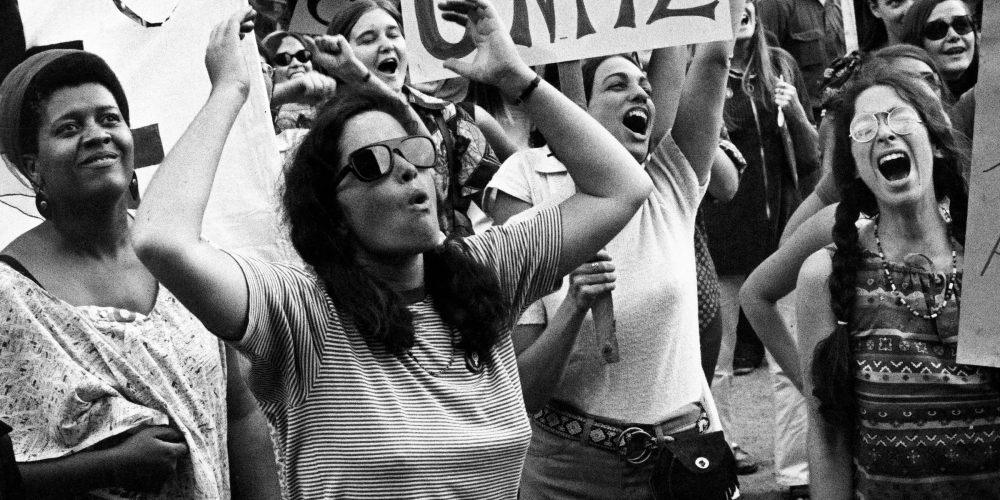
Feminists in the ’60s and ’70s had a slogan that sought to politicize the household: The personal is political. The rallying cry was meant to challenge traditional family values and the expectation that women should be caring wives and mothers who looked after the home. Breaking free from the “prison” of the nuclear family was described as “liberating” for American women.
So-called “student activists” and “black liberation” groups adopted the argument for their own purposes, and protest movements sought out ways to invade Americans’ private spaces. The idea was to make people feel uncomfortable so that they were forced to acknowledge whatever “issues” protesters were pushing. Feminists, anti-war activists, and civil rights protesters targeted citizens in restaurants, movie theaters, parks, churches, and shopping districts. They made it impossible for ordinary families to enjoy ordinary days without being force-fed heaping spoonfuls of acidic politics.
These kinds of aggressive tactics that politicize every part of life have come with tremendous costs. Generations of women increasingly resented their traditional roles as wives and mothers. Rising divorce rates fractured the stability of nuclear families. Divorced men abandoned their children. Children grew up without both male and female role models. Young adults entered the workforce before first acquiring basic social skills normally developed during childhood.
More broadly, society suffered because the space between the political sphere and the social sphere entirely disappeared. Society and the political State are not the same thing. Government, laws, taxes, and mandates come with either the application or threat of force. The political State is coercion. Society, on the other hand, is much broader. It includes a people’s religion, customs, traditions, history, and familiar interactions. Those influences certainly “push” people to behave in certain ways, but there is considerable room for disagreement and compromise. Society is cooperation.
It would be difficult for young Americans to appreciate this fact, but seventy years ago, much of the social sphere flourished beyond the reach of raw politics. Men belonged to veterans’ organizations, bowling leagues, and public service groups. Women volunteered to help local schools, held book clubs, and organized social gatherings. Children attended summer camps, worked low-wage jobs, and participated in school clubs. Families attended church and enjoyed local festivals. Neighborhood functions brought entire blocks of families together. “Belonging” to things mattered to people. Membership numbers for recreational clubs and civic organizations during the first half of the twentieth century were much higher than they are today.
Politics did not always dominate American society.
Nostalgic Hollywood writers have become increasingly fond of portraying life before personal computers and cell phones. When they depict suburban streets in the ’80s, several things always pop out. Children are riding bikes and exploring the world as far as their legs can take them. Parents have no problem punishing kids when they misbehave. And politics is just one small part of community life. In order to drive this last point home, yard signs for Democrats and Republicans are shown side by side to remind Americans of a time when neighbors didn’t attack each other because of their personal political beliefs.
Today, not only are computers and cell phones everywhere, but also politics is everywhere. Schools teach children to become “activists” before they’re even teens. Instead of riding bikes and exploring the world, kids regurgitate talking points about “transgenderism,” abortion, “right-wing” fascism, “white supremacy,” and the “patriarchy.” And toleration for other people’s political beliefs no longer exists. Yard signs are defaced or stolen. Political slogans and Antifa threats are graffitied onto churches, businesses, and even homes.

Several generations of Americans have been taught that “the personal is political,” and because of that, tens of millions of Americans now see every political opponent as a personal threat. When every person with an opposing point of view is labeled a “threat,” it is impossible not to see “oppression” everywhere. Young Americans have been so indoctrinated to believe that their opinions are “correct” and that contrary opinions are “dangerous” that they think it is both rational and reasonable to censor disagreement as “hate speech,” punish “thought criminals,” and hide behind the imaginary walls of a “safe space.”
If only they understood that society was filled with safe spaces before leftist activists politicized everything. Little league games and swim competitions were opportunities for kids to compete athletically — not physically dangerous clown shows for adults to preach about boys being “girls.” Town festivals did not begin with “land acknowledgments” or other mayoral decrees informing the locals that they’re “oppressive colonialists” and “bigots.” School clubs did not obsess about “diversity, inclusion, and equity.” Republican-voting families and Democrat-voting families still laughed together at backyard barbecues. When Americans were not worried about “triggering” each other with harmless words, they could enjoy one another’s company and build social bonds that mattered more than personal political beliefs. Safe spaces existed everywhere because politics did not.
As just one pertinent example of how politicized civic organizations have become, recently leaked training documents from the country’s largest public school teachers’ union show outright hostility toward Republican parents. Without even the pretense of impartiality, the National Education Association advises teachers, “Over the last ten years, Republicans in state legislatures have increasingly turned to anti-transgender rhetoric and legislation as a powerful complement to their arsenal of racist dog whistles used to whip up fear and consolidate power.”
Moreover, the NEA insists, “The right has exploited ignorance about transgender people and our lack of an affirmative, race-forward message to advance anti-trans attacks, further splinter and impugn the left, and sabotage progressives on a broad range of issues.”
The NEA encourages teachers to “name the villains who violate our values.” Why must teachers inject such partisan political messages into their classrooms? The NEA provides the answer: because “certain politicians are pushing laws that restrict our freedoms because of the color of our skin, what’s in our wallets, or because we are transgender” and because those politicians “exploit divisions and fears among us so they can get and hold onto power, denying us the basic rights, resources, and respect all people deserve.” Nothing screams, “The personal is political!” quite like public schools teaching children that Republicans are “villains” and “oppressors” who do not deserve to be parents.
The politicization of everything always begins with the politicization of language. Unconstitutional race-based admissions and hiring practices are defended as “virtues” of “diversity, inclusion, and equity.” Market-distorting corporate preferences for the moneymaking “climate change” racket and other leftist political causes are justified as “environmental, social, and governance” ethics issues.
Our political programmers insist that “trans-women are real women” and expect fathers to watch boys physically abuse their daughters. On this issue, the NEA instructs teachers to lie by “supporting transgender women athletes as part of the broader fight for equality in girls’ and women’s sports” and by “connecting attacks on trans women athletes to the long legacy of discrimination against all women athletes.” The teachers’ unions have no shame.
As Democrats ruin Thanksgiving celebrations this year by lecturing their extended families on why “Trump is Hitler” and “Republicans are evil,” try to remember that this social catastrophe did not arrive overnight. Leftists since Marx have been destroying society and cultural unity by politicizing everything in society and our culture. Democrats have destroyed our personal connections by politicizing our relationships. The end result is that the political sphere — and its enforcer, the State — have crushed the family, community, and society.
To remedy our plight and subdue leftism for good, family, community, and society will have to make a comeback. We do that one conversation at a time.
Bypass Big Tech Censors

Starting the Day With a Scripture-Inspired Roast Helps Center Your Thoughts on Eternal Truths Amid Temporal Pressures
The world can seem chaotic, especially right after we wake up. Many believers start their mornings reaching for something familiar — a hot cup of coffee — yet end up settling for mediocre brews that do little more than deliver a caffeine jolt. The daily grind of life, with its endless distractions, news cycles, and responsibilities, can leave even the most faithful feeling spiritually parched alongside their physical fatigue. What if your morning ritual could do more than wake you up? What if it could ground you in truth, nourish your body with exceptional quality, and quietly advance a kingdom purpose at the same time?
That’s the promise — and the reality — behind Promised Grounds Coffee. This Christian-founded company doesn’t just roast beans; it approaches every step as an act of worship and discipleship. By selecting only the top 10% of specialty-grade beans, ethically sourced from dedicated farmers in Central and South America, and small-batch roasting them with reverence in Austin, Texas, Promised Grounds delivers what many describe as the best coffee available — never burnt, never bland, but rich with origin stories and layered flavors that honor God’s creation.
From the vibrant Psalm 27 Roast (a light, bright medium option) to the bold yet peaceful 2 Timothy 1:7 Decaf, each bag carries a Scripture verse that turns your daily pour into a gentle reminder of faith. And through their Ounce Per Ounce Promise, every ounce of coffee you enjoy provides an equal ounce of clean water to families in need via partnership with Filter of Hope — literally brewing hope for body and soul, one cup at a time.
The challenge for today’s Christians runs deeper than finding a decent cup. In an age of convenience-driven consumerism, it’s easy to support companies that dilute values or remain silent on matters of faith. Many believers want their everyday choices — from what they drink to how they spend — to reflect discipleship rather than just convenience. Promised Grounds solves this by weaving Christian excellence into the entire process: beans nurtured with prayerful stewardship by farming families, roasted as an offering rather than a commodity, and packaged with Bible verses to encourage a mindset of gratitude and purpose from the first sip. Reviewers consistently praise the smooth, rich profiles — whether enjoyed black in a drip maker, iced on a warm day, or shared in fellowship — noting how the quality stands toe-to-toe with premium secular brands while delivering something far more meaningful.
This integration of faith and flavor addresses a real need in Christian households and ministries. Busy parents, church leaders, and remote workers alike report that starting the day with a Scripture-inspired roast helps center their thoughts on eternal truths amid temporal pressures. The coffee’s exceptional character — bright citrus notes in lighter roasts or deep chocolate undertones in bolder ones — comes from meticulous selection and careful roasting that respects the bean’s natural gifts rather than masking them. It’s the kind of coffee that elevates a simple quiet time, fuels productive workdays, or sparks meaningful conversations when shared at Bible studies or outreach events. And because it’s ethically sourced with integrity, every purchase supports sustainable livelihoods for farmers who treat their crops like family harvests.
For those leading churches or small groups, the impact multiplies. Promised Grounds offers bundles and options perfect for hospitality ministries, turning ordinary coffee service into an opportunity to point people toward the living water of Christ. Imagine greeting visitors with a warm cup whose very bag carries God’s Word — a subtle yet powerful witness that aligns with the Great Commission. The company’s Texas roots and commitment to “brewing hope” resonate especially with believers who value American enterprise paired with global compassion.
Of course, quality alone isn’t enough if the experience feels out of reach. Promised Grounds keeps it accessible with practical perks like free shipping on orders over $40, sample sets for discovering favorites, and thoughtful add-ons such as faith-themed mugs. Whether you prefer whole beans for fresh grinding, grounds for convenience, or even bulk options for larger households and ministries, the result is consistently superior coffee that makes discipleship feel integrated rather than added on.
As you consider how to align even the smallest habits with your walk with God, Promised Grounds Coffee stands out as a refreshing solution. It tackles the dual problems of subpar daily sustenance and disconnected consumption by offering a product that genuinely excels in taste while advancing a mission of clean water, farmer dignity, and scriptural encouragement. Believers who make the switch often describe it as more than a beverage upgrade — it becomes part of their rhythm of gratitude, a daily invitation to remember that every good gift comes from above.
If you’re ready to transform your mornings (and perhaps your church gatherings) with coffee that honors both exceptional craftsmanship and Christian values, I encourage you to explore what Promised Grounds has to offer. One sip at a time, you’ll be nourishing your body, refreshing your spirit, and participating in something far greater — all while enjoying what truly is among the best coffee available.