(The Economic Collapse Blog)—Are we witnessing a surge in the polls that will ultimately decide this election? At this time in 2016, Hillary Clinton had an enormous lead over Donald Trump, but over the last several weeks of the campaign the polls dramatically tightened. The more that the American people saw Donald Trump, the more they liked him. And the more that the American people saw Hillary Clinton, the less they liked her. It appears that a very similar thing is happening now. Donald Trump has always been a star, and his massive rallies are an incredibly powerful campaigning tool. No matter how much money Kamala Harris spends, she can’t recreate the same kind of emotional energy that Trump generates, because Kamala Harris is not a star. She simply does not have the ability to move people emotionally the way that Trump does, and it was an enormous mistake for the Democrats to choose her as the nominee.
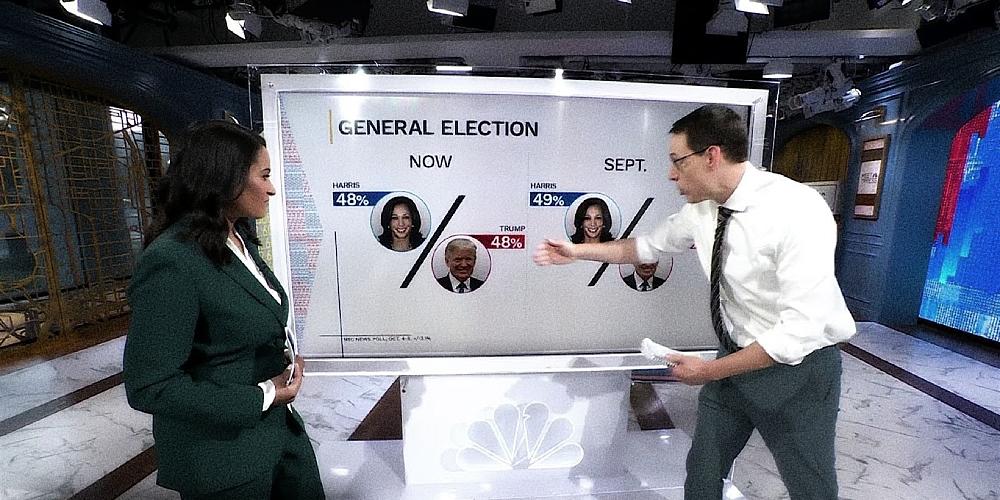
A brand new NBC News national poll shows the momentum that Trump has been able to create in recent weeks.
September’s NBC News national poll had Harris up by five points, but now in the latest poll the two candidates are tied…
In the new poll — which was conducted Oct. 4-8 — Harris gets support from 48% of registered voters in a head-to-head matchup, while Trump gets an identical 48%. Another 4% say they are undecided or wouldn’t vote for either option when forced to choose between those two major-party candidates.
That’s a change from September’s NBC News poll, which found Harris leading Trump by 5 points, 49%-44%, though that result was within the margin of error.
And when third-party candidates are included, that same poll shows that Trump is actually leading…
An expanded ballot including third-party candidates also shows this shift, with 47% of registered voters in the new poll picking Trump, 46% supporting Harris and a combined 7% picking other candidates or saying they’re undecided.
In September, however, Harris held a 6-point lead on this expanded ballot.
The mainstream media kept telling us that this was a “static” race.
But these numbers tell an entirely different story.
During a segment discussing this new poll, Steve Kornacki explained that Donald Trump’s favorability rating is rising and meanwhile the opposite is true for Kamala Harris.
Of course this isn’t the only poll that shows that Trump is building up momentum.

Journalist Mark Halperin says that private polling on both sides shows that the numbers are definitely moving in Trump’s favor right now…
“When I’ve reported over the last several days about private polling” which is favorable to Trump, says @MarkHalperin, “that is not Republican-only private polling. It’s reflected in the Democratic private polling, too. In fact, I think if you’d ask the Harris campaign about their polling, you’d hear a similar story. This is not spin by Republicans about secret or fake polls. This is what is happening in the data. And as we’ve said repeatedly, the public and private data differs. The public data is cheap and has issues in almost every case. It’s just the nature of the beast now for academic and media organizations, not every one, but most.”
This certainly does not mean that Trump has the election wrapped up.
So much could still happen between now and November.
In fact, some very disturbing allegations about Tim Walz are being released as I write this article. So we shall see what happens.
But right now the big online betting markets seem to think that Trump is going to win…
Former President Donald Trump is currently leading Vice President Kamala Harris by 10 points on the Polymarket prediction platform — a sharp reversal over betting odds in September.
According to the latest Polymarket data, Trump currently has a 55% chance of securing the Oval Office in November compared to Harris’ 45% chance.
The former President also reversed Harris’ lead in 4 of 6 swing states and now leads in Arizona, Georgia, Michigan, and Pennsylvania — with Arizona and Georgia representing the GOP candidate’s widest margins of victory.
About a month ago, the Democrats were feeling very confident.
But now panic is clearly starting to set in…
Of course, that has not stopped both parties from doing what they always do. In Democrats’ case, this appears to be the week when their traditional preëlection panic has set in. Strategists are now warning that Harris has “plateaued,” that she “needs to be more aggressive,” and that she has to reinvent herself as a centrist to “seal the deal.” In recent days, I’ve read articles dissecting her challenges with male voters, Black male voters, Arab voters, Latino voters, Pennsylvania, Michigan, and Wisconsin voters. She also, apparently, has a Biden problem, a Bibi problem, and a hurricane problem.
Harris just isn’t very inspiring at all, and many people find her to be extremely annoying.
These flaws torpedoed her run for the presidency in 2020, and they are likely to be fatal this time around too.
If you want to run for president and win, you need to be a star.
It really is that simple.
The reason why Trump draws such large crowds to his rallies is because millions upon millions of Americans absolutely adore him.
That also makes Trump a target, and it appears that a “third assassination attempt” was just thwarted…
A third assassination attempt against former President Donald Trump was thwarted on Saturday after a Las Vegas man was arrested with weapons and fake passes about a half mile from Trump’s campaign rally in Coachella Valley, Riverside County Sheriff Chad Bianco said Sunday.
Deputies assigned to Trump’s rally said the driver, Vem Miller, rolled up in a black SUV to a checkpoint at the intersection of Avenue 52 and Celebration Drive around 5 p.m. He was found to be in illegal possession of a shotgun, loaded handgun, and a high-capacity magazine, the Riverside County Sheriff’s Department said in a news release.
Bianco told the Southern California News Group on Sunday that he believes Miller — who he said is a member of a right–leaning anti-government group — planned to kill Trump and that deputies thwarted the plan when Miller presented fake VIP and press passes at a checkpoint.
“They were different enough to cause the deputies alarm,” Bianco said. “We probably stopped another assassination attempt.”
As I have stated before, it really will be a miracle if Trump actually makes it to the election.
And no matter who ultimately emerges victorious, the truth is that we are a bitterly divided nation that is rapidly heading in the wrong direction.
Whether Trump wins or Harris wins, I am expecting tremendous civil unrest following the outcome of this election.
So those that are looking at election day as the finish line are getting it all wrong.
This election will not be the end of anything. Instead, it will simply be the beginning of an entirely new chapter.

Michael’s new book entitled “Why” is available in paperback and for the Kindle on Amazon.com, and you can subscribe to his Substack newsletter at michaeltsnyder.substack.com.
Bypass Big Tech Censors

Starting the Day With a Scripture-Inspired Roast Helps Center Your Thoughts on Eternal Truths Amid Temporal Pressures
The world can seem chaotic, especially right after we wake up. Many believers start their mornings reaching for something familiar — a hot cup of coffee — yet end up settling for mediocre brews that do little more than deliver a caffeine jolt. The daily grind of life, with its endless distractions, news cycles, and responsibilities, can leave even the most faithful feeling spiritually parched alongside their physical fatigue. What if your morning ritual could do more than wake you up? What if it could ground you in truth, nourish your body with exceptional quality, and quietly advance a kingdom purpose at the same time?
That’s the promise — and the reality — behind Promised Grounds Coffee. This Christian-founded company doesn’t just roast beans; it approaches every step as an act of worship and discipleship. By selecting only the top 10% of specialty-grade beans, ethically sourced from dedicated farmers in Central and South America, and small-batch roasting them with reverence in Austin, Texas, Promised Grounds delivers what many describe as the best coffee available — never burnt, never bland, but rich with origin stories and layered flavors that honor God’s creation.
From the vibrant Psalm 27 Roast (a light, bright medium option) to the bold yet peaceful 2 Timothy 1:7 Decaf, each bag carries a Scripture verse that turns your daily pour into a gentle reminder of faith. And through their Ounce Per Ounce Promise, every ounce of coffee you enjoy provides an equal ounce of clean water to families in need via partnership with Filter of Hope — literally brewing hope for body and soul, one cup at a time.
The challenge for today’s Christians runs deeper than finding a decent cup. In an age of convenience-driven consumerism, it’s easy to support companies that dilute values or remain silent on matters of faith. Many believers want their everyday choices — from what they drink to how they spend — to reflect discipleship rather than just convenience. Promised Grounds solves this by weaving Christian excellence into the entire process: beans nurtured with prayerful stewardship by farming families, roasted as an offering rather than a commodity, and packaged with Bible verses to encourage a mindset of gratitude and purpose from the first sip. Reviewers consistently praise the smooth, rich profiles — whether enjoyed black in a drip maker, iced on a warm day, or shared in fellowship — noting how the quality stands toe-to-toe with premium secular brands while delivering something far more meaningful.
This integration of faith and flavor addresses a real need in Christian households and ministries. Busy parents, church leaders, and remote workers alike report that starting the day with a Scripture-inspired roast helps center their thoughts on eternal truths amid temporal pressures. The coffee’s exceptional character — bright citrus notes in lighter roasts or deep chocolate undertones in bolder ones — comes from meticulous selection and careful roasting that respects the bean’s natural gifts rather than masking them. It’s the kind of coffee that elevates a simple quiet time, fuels productive workdays, or sparks meaningful conversations when shared at Bible studies or outreach events. And because it’s ethically sourced with integrity, every purchase supports sustainable livelihoods for farmers who treat their crops like family harvests.
For those leading churches or small groups, the impact multiplies. Promised Grounds offers bundles and options perfect for hospitality ministries, turning ordinary coffee service into an opportunity to point people toward the living water of Christ. Imagine greeting visitors with a warm cup whose very bag carries God’s Word — a subtle yet powerful witness that aligns with the Great Commission. The company’s Texas roots and commitment to “brewing hope” resonate especially with believers who value American enterprise paired with global compassion.
Of course, quality alone isn’t enough if the experience feels out of reach. Promised Grounds keeps it accessible with practical perks like free shipping on orders over $40, sample sets for discovering favorites, and thoughtful add-ons such as faith-themed mugs. Whether you prefer whole beans for fresh grinding, grounds for convenience, or even bulk options for larger households and ministries, the result is consistently superior coffee that makes discipleship feel integrated rather than added on.
As you consider how to align even the smallest habits with your walk with God, Promised Grounds Coffee stands out as a refreshing solution. It tackles the dual problems of subpar daily sustenance and disconnected consumption by offering a product that genuinely excels in taste while advancing a mission of clean water, farmer dignity, and scriptural encouragement. Believers who make the switch often describe it as more than a beverage upgrade — it becomes part of their rhythm of gratitude, a daily invitation to remember that every good gift comes from above.
If you’re ready to transform your mornings (and perhaps your church gatherings) with coffee that honors both exceptional craftsmanship and Christian values, I encourage you to explore what Promised Grounds has to offer. One sip at a time, you’ll be nourishing your body, refreshing your spirit, and participating in something far greater — all while enjoying what truly is among the best coffee available.