(Zero Hedge)—Two weeks after a sudden flareup over Chinese rare earth mineral exports nearly sparked another market meltdown, the issue has been resolved, at least according to the Trump admin.
According to a fact sheet published by the White House on Saturday which outlined some details of the trade pact agreed to earlier this week by President Trump and Chinese leader Xi Jinping, China will effectively suspend implementation of additional export controls on rare earth metals and will issue general licenses valid for exports of rare earths, gallium and germanium “for the benefit of U.S. end users and their suppliers around the world” meaning the effective removal of controls China imposed in April 2025 and October 2022. The US and China previously said Beijing would suspend more restrictive controls announced in October 2025 for one year.
Washington will also pause some of Trump’s so-called reciprocal tariffs on China for an additional year and is halting plans to implement a 100% tariff on Chinese exports to the US that was threatened for November. The White House also said that the US will further extend the expiration of certain Section 301 tariff exclusions, currently due to expire on Nov. 29, 2025, until Nov. 10, 2026.
Meanwhile, China will also terminate investigations targeting US companies in the semiconductor supply chain, including those into Nvidia and Qualcomm, Bloomberg reported.
However, skepticism emerged about the viability of the deal after comparing the readouts of what the White House said was agreed to, and that published by Beijing: what emerges are several key disagreements, prompting some China experts to conclude that “there is no deal” and that “we’re going to be doing this again in 1-2 months.”
First pic is what USA said China agreed to do
Second and third pics are what China said about the meeting
Doesn’t seem like there is a consensus https://t.co/VcvV7uV21f pic.twitter.com/GFRsDqZYd6
— molson ?⚙️ (@Molson_Hart) November 2, 2025
It also means that even a small hiccup in the already tense relations between the two countries likely means a reversion to the trade war status quo, threats of more tariffs by the US and rare earth retaliation by Beijing.
To that point, Treasury Secretary Scott Bessent said Sunday that despite deals, the US and its allies need to be wary of China.
“This is a problem that has been with us for several decades, it’s never been addressed with these rare earths, the rare earth magnets,” Bessent said on Fox News Sunday. “The Chinese have cornered the market, and unfortunately, at times, they proved to be unreliable partners.”

Bessent added that he hoped “we can depend on them to be more reliable partners” after the implementation of the deal.
The grumpy old men at The Wall Street Journal’s editorial board think China’s rare earth restrictions were a surprise.
China has been planning this for 30 years while the U.S. was asleep at the switch.
We’re wide awake now, rallying our allies and de-risking global supply… pic.twitter.com/fjkoRuY8bI
— Treasury Secretary Scott Bessent (@SecScottBessent) November 2, 2025
Later on Sunday, Trump appeared on 60 Minutes after a 5 year hiatus, and said that “I got sort of everything that we wanted,” of his meeting with Chinese President Xi Jinping.
“I mean, we’re doing very well with China, and hopefully they’re gonna do very well with us,” adding that China’s threat of rare earths restrictions has “gone.”
The grumpy old men at The Wall Street Journal’s editorial board think China’s rare earth restrictions were a surprise.
China has been planning this for 30 years while the U.S. was asleep at the switch.
We’re wide awake now, rallying our allies and de-risking global supply… pic.twitter.com/fjkoRuY8bI
— Treasury Secretary Scott Bessent (@SecScottBessent) November 2, 2025
Many hardly share Trump’s view, noting that the deal at most gives the US a 1 year period in which to launch an Operation Warp Speed 2.0 (see below) in which to boost domestic production and reroute supply chains in order to make the US self-reliant on rare earths, a massive challenge in a world where China is the defacto sole-source of refined RE.
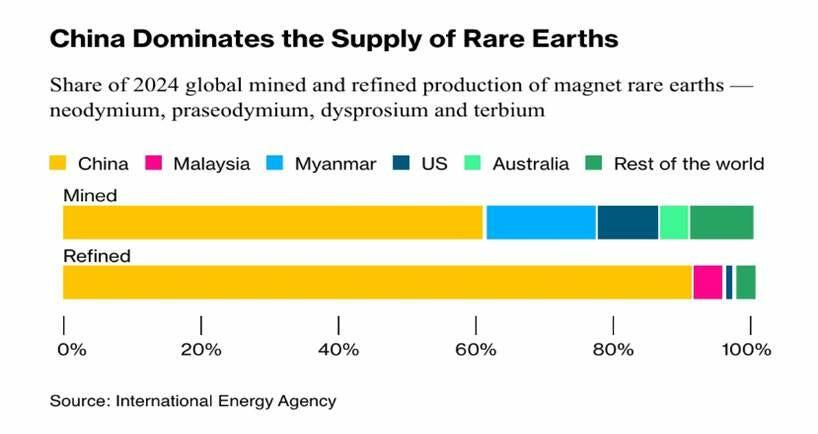
The landmark summit between Trump and Xi, their first face-to-face meeting of the US president’s second term, saw the leaders stabilize relations in the short term after an escalating trade fight that had roiled markets and sparked fears of a global downturn.
Under their agreement, according to the White House, China agreed to pause sweeping controls on rare-earth magnets in exchange for a US agreement to roll back an expansion of curbs on Chinese companies. China had used its dominance in the processing of rare-earth minerals as leverage, threatening to restrict their flow to the US and allies countries.
The US also agreed to halve a fentanyl-related tariff to 10% from 20%, while Beijing will resume purchases of American soybeans and other agricultural products. The US has said China will buy 12 million metric tons of soybeans during the current season, and a minimum of 25 million metric tons a year for the next three years. Trump on Friday indicated he would like to remove all of the fentanyl-related tariffs if China continued to crack down on exports of the drug and precursor chemicals used to make it.
“As soon as we see that, we’ll get rid of the other 10%,” Trump told reporters aboard Air Force One on Friday.
The US also said on Saturday that Beijing will take steps to allow the Chinese facilities of Dutch chipmaker Nexperia BV to resume shipments, confirming a Bloomberg report from a day earlier. This move will likely ease worries about chip shipments that had threatened auto production as a trade fight between China and the US escalated.
But as Bloomberg notes, while the agreement has calmed tensions, the pact may be a short-term truce in an extended trade fight with the measures just meant to last one year. And despite addressing some key issues – and with both sides winning key concessions – the agreement fails to comprehensively address all of the issues at the heart of the US-China trade fight and other geopolitical flashpoints such as Taiwan and Russia’s war in Ukraine.
According to an analysis by TS Lombard’s Grace Fan (available to pro subs), amid Trump’s flurry of Asia dealmaking, capped by a fresh US-China trade war détente, “the spectre of escalation remains bracingly in view, after Trump unexpectedly threw open the door to new US nuclear weapons testing for the first time in three decades to counter Russia/China.”
That said, investors can take comfort in the détente’s ‘deliverables’ as keeping a risk-on market rally on both sides of the Pacific alive, including: 1) A 10% cut in US tariffs on China aided by Chinese purchases of US soy (+25mmt/yr for 3 yrs); 2) a 1-year delay to both the expanded Chinese 9 Oct rare earth (RE) and the US 29 Sept (“Affiliates”) export controls rules; and 3) a 1-year delay of new bilateral shipping fees. Left out was Taiwan, TikTok and Nvidia’s Blackwell chips, suggesting more market upside when and if a latter deal ultimately gets greenlit as we expect.

Fan notes that aided by his Rare Earths trump card, Xi scored two big wins:
- Delayed US “Affiliates Rule”. This is one of the first known instances of China successfully rolling back a major US chip export control expansion but likely not the last. In a big shift owing to Trump’s transactionalism, US national security is now on the bargaining table in a way it never was before. An estimated 20,000 affiliates at least 50% owned by Chinese blacklisted entities and caught in the rule’s dragnet could be let off (e.g., Dutch-based chipmaker Nexperia), easing recent supply chain constraints for automakers among other firms.
- Immediate 10% fentanyl tariff cut = more level playing field with ASEAN. China’s now lower tariff rate (+20% under Trump 2.0) puts it back in competition with regional exporters, making ASEAN (led by Vietnam) the relative loser here (with +19-20% “reciprocal” tariffs, +40% for transshipments). Still, keep an eye on Trump’s two recently finalized trade deals (Malaysia, Cambodia) plus “framework” agreements (Vietnam, Thailand) as new details are fleshed out.
Trump’s consolation prize are the new RE alliances plus soy purchases. According to TS Lombard, saddled by Beijing’s April 4th Rare Earth export controls, the US is arguably in a worse position now vs pre-Liberation Day. Yet Trump’s flurry of RE deals this week (Japan, Korea, Malaysia, Thailand) offers hope that a valuable lesson may have been learnt: the only way out of the RE trap is working with allies on ‘Operation Warp Speed’ 2.0. Trump’s go-ahead for Seoul to build nuclear-powered submarines at a Philly shipyard and clarity on Korea’s $350bn FDI ($150bn for shipbuilding; US$200bn in cash capped at US$20bn/year) also sets the stage for more US reindustrialization – so long as visas are granted.
All this keeps Trump on track for trade war de-escalation by year-end in time for the 2026 midterm election countdown in our base case. What’s still missing: a lot of fine print, USMCA renegotiations, resolution of the Brazil/India 50% tariff disputes and the looming Supreme Court tariff ruling (oral hearing: 5 Nov) that could scramble, however temporarily, Trump’s game plan.
Bypass Big Tech Censors

Two Storms, One Harvest

Every food crisis in living memory has been a one-shock event. The 2008 price spike was a commodity bubble. The 2020 shortages were a logistics failure. The 2022 grain scare was a war on one exporter’s ports. Each time, the system bent, adjusted, and recovered, and each time the experts assured us afterward that global markets are simply too big and too diversified to fail.
What nobody in Washington seems eager to discuss is that 2026 is shaping up to be something the modern food system has never actually faced. Two independent shocks, one climatic and one geopolitical, are converging on the same harvest cycle at the same time. Not sequentially. Simultaneously.
Start with the weather. The Pacific Ocean is currently building toward what forecasters now openly call a record event. NOAA’s Climate Prediction Center puts the odds of at least a strong El Niño near 88 percent, with roughly two in three odds it reaches “very strong” status, the tier reserved for perhaps three or four events in the entire satellite era. Every major global model now projects a median peak in Super El Niño territory, and most of them project it exceeding the 2015-16 event, which until now held the modern record. Sea surface anomalies were already brushing the super threshold in mid-July, months before these events normally peak. The atmosphere has already shifted into El Niño mode, and the event is forecast to crest in late fall and early winter.
This is not about “climate change.” It’s about the standard cycles of weather, and the cycle we’re currently in is one that has likely devastated societies in the past. We’re better prepared as a society today, but not all Americans are equally prepared.
Serious households have started doing the quiet math on their own. Grocery bills tell part of the story, and the forecast maps tell the rest, which is why long-term food storage has moved from fringe hobby to mainstream line item in the family budget, with established suppliers like Heaven’s Harvest seeing demand from people who five years ago would have rolled their eyes at the idea. That instinct is not paranoia. It is pattern recognition, and the pattern is worth walking through carefully.
Editor’s Note: Heaven’s Harvest IS a sponsor, but the warnings of this article are real and would be written even if we didn’t have a survival food sponsor. With that said, those who take advantage of what they offer can use promo code “Patriot” for 15% off.
The Fertilizer Clock Is Already Running
While the Pacific warms, the second shock has been unfolding in the Strait of Hormuz. The conflict with Iran turned the world’s most important energy chokepoint into a contested waterway, and the consequences reach far beyond the gas pump. Roughly a third of global fertilizer trade moves through Hormuz, and the disruption sent urea prices up 86 percent year over year by March, with a 53 percent jump in a single month.
The World Bank projects energy prices rising about 24 percent in 2026 and fertilizer about 31 percent. By its own accounting, fertilizer prices ran 35 percent higher in the first five months of this year than the same period last year.
Here is the mechanism the nightly news will not explain. Fertilizer is not a grocery item. It is a time-delayed input. The nitrogen a farmer in Iowa or Punjab could not afford to apply this spring does not show up as a problem this spring. It shows up as a thinner harvest six to twelve months later.
The World Bank’s own food security brief concedes that the effects of reduced applications earlier this season “are likely to become visible only later in harvest outcomes.” Translate that from institutional language into plain English and it means this. The damage is already done, it is already in the ground, and we are simply waiting for it to arrive on the shelf.
Now check the calendar. Six to twelve months from the spring planting season lands us squarely in late 2026 and early 2027. Which is precisely when the strongest El Niño in the instrumental record is forecast to peak, bringing its signature droughts to Southeast Asia, Australia, southern Africa, northern Brazil, and South Asia, the very regions that grow the world’s rice, sugar, and oilseeds.
The World Bank warns openly that a strong El Niño “could disrupt multiple crop belts simultaneously” on top of the conflict-driven input costs. Their baseline projection assumes the Middle East disruptions ease by autumn. What in the last two years of Middle East history suggests that assumption is safe?
The System Has No Slack Left
The comfortable answer is that global markets always adjust. But adjustment requires slack, and the slack is gone. Global cereal production is expected to decline from last year’s records even before El Niño does its work. The UN World Food Programme, hardly a den of right-wing preppers, is calling this the most significant disruption to its supply chains since Covid and the invasion of Ukraine, and its supply chain director put the stakes bluntly.
Today’s supply chain challenges are tomorrow’s hunger crisis.
There is also a political dimension that markets cannot price. When food gets scarce, governments do not behave like economists. They behave like politicians. Export bans, hoarding mandates, and panic buying at the national level turned the modest rice shortfall of 2008 into a global crisis, and analysts are already warning that import-dependent nations are the first dominoes.
The 2015-16 Super El Niño, a far weaker event than what is now forecast, threw tens of millions into food stress across Africa and Asia. This one is projected to be stronger, and it arrives with fertilizer already rationed by price and shipping lanes already contested by missiles.
What Joseph Knew
Scripture does not treat preparation for lean years as faithlessness. It treats it as wisdom delivered in advance to those willing to act on it.
Behold, there come seven years of great plenty throughout all the land of Egypt: And there shall arise after them seven years of famine; and all the plenty shall be forgotten in the land of Egypt.
Joseph did not respond to that warning with a hashtag or a committee. He stored grain during the years of abundance, and when the famine came, Egypt stood while its neighbors begged. The lesson is not that famine is certain. It is that the time to prepare is precisely when preparation still looks optional.
Nobody who filled a pantry in a year of plenty has ever regretted it, and nobody standing in an empty aisle has ever been glad he waited for certainty.
None of this calls for panic, and panic is the enemy of sound judgment anyway. It calls for the same unglamorous prudence our grandparents considered ordinary. Keep some cash margin, know your local growers, and put real food in deep storage while it is cheap and available, because the entire arc of this story is that cheap and available is a closing window.
Families looking for a straightforward place to start can visit Heaven’s Harvest and use promo code Patriot for 15 percent off long-term storable food. The forecasts may yet soften, the strait may yet reopen, and we should pray they do. But hope is a fine thing to hold and a foolish thing to eat.