
(Zero Hedge)—President Trump’s national industrial strategy centers on expanding U.S. dominance in semiconductors, AI, rare earth production, clean technology, space, and other emerging technologies expected to dominate the global economy in the 2030s. Following the administration’s push to accelerate AI data center buildouts and power grid upgrades, Politico now reports that the next major focus is poised to be humanoid robotics.
Commerce Secretary Howard Lutnick has been meeting with the heads of major tech companies and is weighing an executive order next year to spur domestic development and production of humanoid robots, while the Department of Transportation is setting up a robotics working group, according to Politico sources.
https://t.co/tPmp2Hq1mw pic.twitter.com/VChAa8p7j9
— Brett Adcock (@adcock_brett) December 4, 2025
The timing is notable: Elon Musk’s Tesla is preparing to scale production of its Optimus robot to one million units by the end of next year. Earlier this fall, Tesla reportedly placed a massive order for linear actuators from China, suggesting that Optimus production is set to ramp up in the near term.
Tesla Optimus Robot’s incredible progress after only 2.5 years. pic.twitter.com/ESTXSofJha
— Nic Cruz Patane (@niccruzpatane) December 2, 2025
A Department of Commerce spokesperson told the outlet: “We are committed to robotics and advanced manufacturing because they are central to bringing critical production back to the United States.”
Politico explains more about Trump’s emerging national robotics strategy that could be unveiled early next year:
There’s growing interest on Capitol Hill as well. A Republican amendment to the National Defense Authorization Act would have created a national robotics commission. The amendment was not included in the bill. Other legislative efforts are underway.
Related:
- Goldman Finds “Inflection Point” With Humanoid Robots; We Tested Unitree’s Robodog
- Goldman’s Chat With Top Robotics Firm Reveals Skynet Humanoid Timeline
- China Humanoid Robotics Index Jumps After Unitree Debuts “Stellar Hunter”
Latest reports:
- Humanoid Robot Roundup: Tesla Kicks Off Optimus Pilot Production As Goldman Tours China’s Supply Chain
- Humanoid Robot Roundup: Auto Industry Poised To Lead First Wave Of Adoption
- China Issues Rare Bubble Warning Forming In Humanoid Robotics
The Trump administration understands that this period is a transformational moment in human history, and a point where a national strategy is essential to rapidly boost industrial capacity and position the U.S. as the leader in AI, robots, drones, and chips as the world fractures into a bipolar state amid a technological superpower race with China that goes into hyperdrive over the next decade.

Last week, Morgan Stanley analyst Shawn Kim showed clients that adoption of humanoid robots will top 1 billion units by 2050.
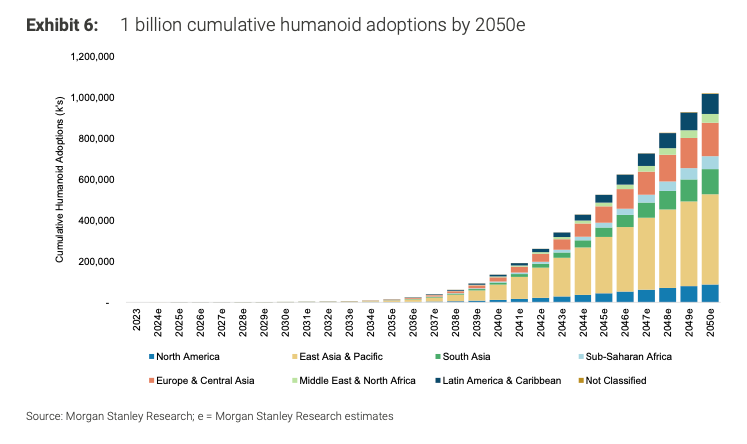
Kim explained:
In their Global Insight report published earlier this year, Morgan Stanley’s global Autos and Industrials teams estimated that global cumulative humanoid adoption could reach 1 billion by 2050. They generally assume a relatively slow pace of adoption until the mid-2030s, after which they believe the pace will begin to materially accelerate into the late 2030s and 2040s, given (1) technological progress across both hardware and AI foundation models, which may take over a decade to create “true” general-purpose humanoids capable of doing the vast majority of useful tasks; (2) price declines as technologies mature and supply chains develop; and (3) greater societal/political acceptance.
ZeroHedge Pro subs can read the full MS report in the usual place. It’s loaded with deeper inudstry analysis and charts that lay out where the whole industry is headed through 2050 as the Trump administration prepares to unveil its national strategy – this report is a must-read.
What Trump is doing today is preparing the nation for the 2030s. Supply chains must be localized, rare earths must be plentiful, and the U.S. must have the industrial capacity to build these innovative technologies domestically or on friendly shores. What you see today is proper stewardship of the nation, versus the previous administration that was so obsessed with nation-killing globalist policies.
Bypass Big Tech Censors

Starting the Day With a Scripture-Inspired Roast Helps Center Your Thoughts on Eternal Truths Amid Temporal Pressures
The world can seem chaotic, especially right after we wake up. Many believers start their mornings reaching for something familiar — a hot cup of coffee — yet end up settling for mediocre brews that do little more than deliver a caffeine jolt. The daily grind of life, with its endless distractions, news cycles, and responsibilities, can leave even the most faithful feeling spiritually parched alongside their physical fatigue. What if your morning ritual could do more than wake you up? What if it could ground you in truth, nourish your body with exceptional quality, and quietly advance a kingdom purpose at the same time?
That’s the promise — and the reality — behind Promised Grounds Coffee. This Christian-founded company doesn’t just roast beans; it approaches every step as an act of worship and discipleship. By selecting only the top 10% of specialty-grade beans, ethically sourced from dedicated farmers in Central and South America, and small-batch roasting them with reverence in Austin, Texas, Promised Grounds delivers what many describe as the best coffee available — never burnt, never bland, but rich with origin stories and layered flavors that honor God’s creation.
From the vibrant Psalm 27 Roast (a light, bright medium option) to the bold yet peaceful 2 Timothy 1:7 Decaf, each bag carries a Scripture verse that turns your daily pour into a gentle reminder of faith. And through their Ounce Per Ounce Promise, every ounce of coffee you enjoy provides an equal ounce of clean water to families in need via partnership with Filter of Hope — literally brewing hope for body and soul, one cup at a time.
The challenge for today’s Christians runs deeper than finding a decent cup. In an age of convenience-driven consumerism, it’s easy to support companies that dilute values or remain silent on matters of faith. Many believers want their everyday choices — from what they drink to how they spend — to reflect discipleship rather than just convenience. Promised Grounds solves this by weaving Christian excellence into the entire process: beans nurtured with prayerful stewardship by farming families, roasted as an offering rather than a commodity, and packaged with Bible verses to encourage a mindset of gratitude and purpose from the first sip. Reviewers consistently praise the smooth, rich profiles — whether enjoyed black in a drip maker, iced on a warm day, or shared in fellowship — noting how the quality stands toe-to-toe with premium secular brands while delivering something far more meaningful.
This integration of faith and flavor addresses a real need in Christian households and ministries. Busy parents, church leaders, and remote workers alike report that starting the day with a Scripture-inspired roast helps center their thoughts on eternal truths amid temporal pressures. The coffee’s exceptional character — bright citrus notes in lighter roasts or deep chocolate undertones in bolder ones — comes from meticulous selection and careful roasting that respects the bean’s natural gifts rather than masking them. It’s the kind of coffee that elevates a simple quiet time, fuels productive workdays, or sparks meaningful conversations when shared at Bible studies or outreach events. And because it’s ethically sourced with integrity, every purchase supports sustainable livelihoods for farmers who treat their crops like family harvests.
For those leading churches or small groups, the impact multiplies. Promised Grounds offers bundles and options perfect for hospitality ministries, turning ordinary coffee service into an opportunity to point people toward the living water of Christ. Imagine greeting visitors with a warm cup whose very bag carries God’s Word — a subtle yet powerful witness that aligns with the Great Commission. The company’s Texas roots and commitment to “brewing hope” resonate especially with believers who value American enterprise paired with global compassion.
Of course, quality alone isn’t enough if the experience feels out of reach. Promised Grounds keeps it accessible with practical perks like free shipping on orders over $40, sample sets for discovering favorites, and thoughtful add-ons such as faith-themed mugs. Whether you prefer whole beans for fresh grinding, grounds for convenience, or even bulk options for larger households and ministries, the result is consistently superior coffee that makes discipleship feel integrated rather than added on.
As you consider how to align even the smallest habits with your walk with God, Promised Grounds Coffee stands out as a refreshing solution. It tackles the dual problems of subpar daily sustenance and disconnected consumption by offering a product that genuinely excels in taste while advancing a mission of clean water, farmer dignity, and scriptural encouragement. Believers who make the switch often describe it as more than a beverage upgrade — it becomes part of their rhythm of gratitude, a daily invitation to remember that every good gift comes from above.
If you’re ready to transform your mornings (and perhaps your church gatherings) with coffee that honors both exceptional craftsmanship and Christian values, I encourage you to explore what Promised Grounds has to offer. One sip at a time, you’ll be nourishing your body, refreshing your spirit, and participating in something far greater — all while enjoying what truly is among the best coffee available.