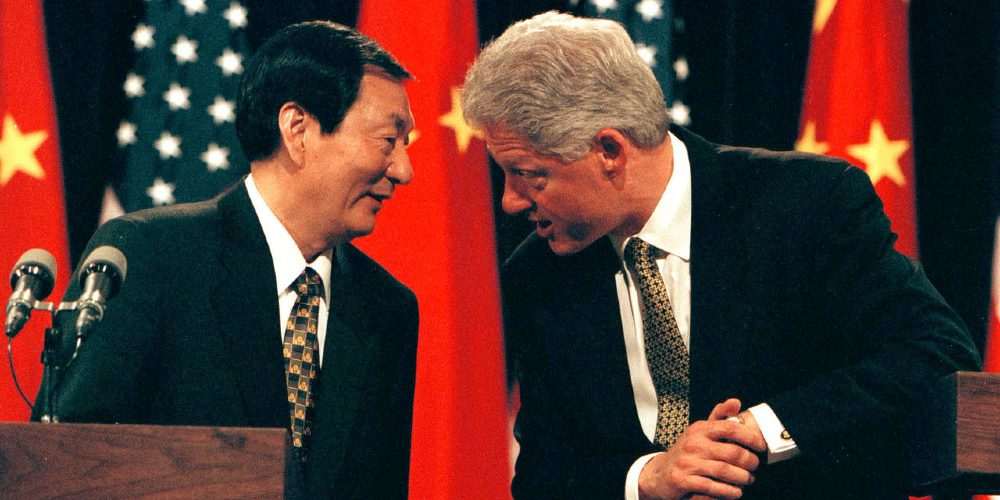
Twenty-five years ago, President Clinton used his remaining time in office to advocate on China’s behalf. He argued that the communist regime should be admitted to the World Trade Organization and that the United States should grant the totalitarian state permanent normal trade relations.
Critics of China pointed to the Tiananmen Square Massacre the decade before as ample reason to deny it any economic reward. Critics of Clinton pointed to allegations that his political campaign had accepted illicit contributions from China as ample reason to doubt the president’s motives. Still, Clinton got what he wanted, and China became a member of the WTO the very next year.
In truth, Clinton was only a loud voice representing a conglomerate of international business interests that had long desired to grow profits by tapping into China’s abundant supply of slave labor. They don’t teach that nugget of truth to the kiddies suffering through public school indoctrination.
The Marxists who control the teachers’ unions and write the textbooks advance the common narrative that Clinton’s efforts to welcome China into the planet’s most lucrative trade clubs were part of a larger, well intentioned foreign policy plan to westernize China and make the communist country more like us. Would you believe that thousands of American businesses moved their operations to China over the last two-plus decades because they were eager to liberalize the communist nation, institute massive workplace regulations, utilize more expensive “green” energies, and constantly hike China’s minimum wage? Me neither.
Slave labor was always the point. Building things in a totalitarian nation that brutalizes striking workers and imprisons agitators in labor camps was always the point. Moving operations to a country that doesn’t give a fig about protecting the environment or workers’ health was always the point. The foreign policy crowd can pretend that enriching the Chinese Communist Party with global trade was some brilliant gambit to turn China into Norway, but the economic titans who pushed that public propaganda were actually looking for cheap workers with no rights.
They weren’t interested in liberating a billion Chinese; they were interested in liberating themselves from expensive environmental and labor regulations in the United States. They offshored their workforces to take advantage of slavery by proxy.
Until Clinton helped to secure China’s membership in the WTO, the communist nation was on the ropes. It could barely feed its people. It had a third-world economy. Despite the United Kingdom’s handover of Hong Kong in ’97, the Chinese Communist Party remained an international pariah after its slaughter of students protesting for democracy. There was no reason to reward China’s human rights abuses by elevating it on the international stage.
There was no reason to suspect that a dangerous new “Cold War” would develop between a wealthy United States and an impoverished China unless the former offered the latter normalized trade relations. Had Clinton and his Western allies maintained economic pressure on China, it is likely that there would be no Chinese Communist Party today. It would be buried in an unmarked grave alongside Nazi Germany and the Soviet Union — which would have been fitting, since each totalitarian system murdered and disposed of millions the same way.

Instead, the Chinese Communist Party has grown only more powerful over the last twenty-five years. China has become the planet’s premier manufacturing hub. Klaus Schwab’s World Economic Forum globalists are so envious of China’s technocratic surveillance that they regularly promote programs meant to remake the West in China’s image. Warren Buffett’s right-hand man, the now-deceased Charlie Munger, was a huge fan of the way Chinese communists controlled their economy.
The U.S. trade deficit with China was around five billion dollars in the mid-’80s. It has spiked to nearly four hundred billion dollars today! Excluding services and energy, mining, and agricultural products, the U.S. is running a manufacturing deficit of roughly half a trillion dollars with China every year. Since Clinton and the foreign policy gurus opened America’s doors to Chinese goods, the United States has outsourced most of its manufacturing to its chief geopolitical adversary.
Now, that’s a brilliant foreign policy! Three decades ago, China’s economy was fragile, and its future was uncertain. And though many economists would argue that China’s economy is still fragile today (centrally controlled communist systems always are), the Chinese Communist Party has never been more powerful. It has the largest military in the world, is expanding its naval and hybrid warfare capabilities at an exponential pace, and is becoming a real threat to American military supremacy.
The China trade enthusiasts told us that offshoring American manufacturing jobs to the other side of the world would prevent a future devastating conflict with China and transform the communist regime into friendly business partners who would grow to appreciate the benefits of freedom and democracy. Instead, U.S. politicians and business leaders destroyed America’s industrial and manufacturing self-sufficiency while transferring trillions of dollars of wealth to China’s military.
Well done, “expert” class! What will you think of next — maybe fund reckless bioweapon experiments in a leaky Chinese laboratory? D’oh! — the “best and brightest” already have.
I get so angry when I see abandoned factories and dilapidated business districts across the United States. These places are not just reminders of lost jobs; they’re the rusty, dusty remains of lost lives. They weren’t just opportunities for a paycheck; they were opportunities for families to build happy homes and take care of their children. They gave people purpose. They united local communities. They were the backbone of the middle class.
Then came NAFTA, and millions of blue-collar jobs disappeared to Mexico and Central America. When Clinton and his friends partnered with the Chinese Communist Party, America’s working class was hollowed out. Oh, sure, Clinton promised betrayed workers that they would all soon have high-paying jobs in a new service sector that would magically appear. It turned out that Wall Street bankers got those jobs.
Main Street workers were even passed over for over-the-phone customer service positions; the same people who sent America’s best dirty jobs to China figured out they could save a bundle by redirecting business calls to sweatshops in India. Long before corporate news reporters hectored fired mineworkers to “learn to code,” America’s most obnoxious “free traders” were telling fired factory workers that they’d all have high-paying “service jobs” in the “new economy.” They got welfare checks, deadly drugs, and decades of empty promises instead.
The end result of all this offshoring was the growth of an American wasteland. Politicians do their best to hide the evidence. They turn crumbling workshops and warehouses into high-end apartments. They build highways over forgotten neighborhoods. Entire towns in parts of the South and Midwest are all but erased from online maps. Like sepulchers in a cemetery overrun with weeds, the temples once housing America’s vibrant industry lie in ruins. Boarded-up buildings are skeletal monuments to the workingman’s better days.
Why? So that national companies could become international behemoths? So that global firms on Wall Street could strip America down like a stolen car and sell the parts? So that Charlie Munger’s friends could make a fortune on Chinese investments and Klaus Schwab’s friends could push the West toward a technocratic dystopia more easily controlled? So that the wealthiest in America could extract every last dollar from the mortgaged, indebted middle class?
NAFTA was sold as a “free trade” agreement that would slow inflation, decrease national debt, and end illegal immigration (because workers would remain south of the border). Normalized trade relations with China were sold as a policy that would diminish the national security threat of the Chinese Communist Party. How did those promises turn out?
Building an American future begins with revitalizing America’s builders. Combined with deregulation, energy production, and tax cuts, that’s what Trump’s tariffs will do.

Bypass Big Tech Censors
Two Storms, One Harvest

Every food crisis in living memory has been a one-shock event. The 2008 price spike was a commodity bubble. The 2020 shortages were a logistics failure. The 2022 grain scare was a war on one exporter’s ports. Each time, the system bent, adjusted, and recovered, and each time the experts assured us afterward that global markets are simply too big and too diversified to fail.
What nobody in Washington seems eager to discuss is that 2026 is shaping up to be something the modern food system has never actually faced. Two independent shocks, one climatic and one geopolitical, are converging on the same harvest cycle at the same time. Not sequentially. Simultaneously.
Start with the weather. The Pacific Ocean is currently building toward what forecasters now openly call a record event. NOAA’s Climate Prediction Center puts the odds of at least a strong El Niño near 88 percent, with roughly two in three odds it reaches “very strong” status, the tier reserved for perhaps three or four events in the entire satellite era. Every major global model now projects a median peak in Super El Niño territory, and most of them project it exceeding the 2015-16 event, which until now held the modern record. Sea surface anomalies were already brushing the super threshold in mid-July, months before these events normally peak. The atmosphere has already shifted into El Niño mode, and the event is forecast to crest in late fall and early winter.
This is not about “climate change.” It’s about the standard cycles of weather, and the cycle we’re currently in is one that has likely devastated societies in the past. We’re better prepared as a society today, but not all Americans are equally prepared.
Serious households have started doing the quiet math on their own. Grocery bills tell part of the story, and the forecast maps tell the rest, which is why long-term food storage has moved from fringe hobby to mainstream line item in the family budget, with established suppliers like Heaven’s Harvest seeing demand from people who five years ago would have rolled their eyes at the idea. That instinct is not paranoia. It is pattern recognition, and the pattern is worth walking through carefully.
Editor’s Note: Heaven’s Harvest IS a sponsor, but the warnings of this article are real and would be written even if we didn’t have a survival food sponsor. With that said, those who take advantage of what they offer can use promo code “Patriot” for 15% off.
The Fertilizer Clock Is Already Running
While the Pacific warms, the second shock has been unfolding in the Strait of Hormuz. The conflict with Iran turned the world’s most important energy chokepoint into a contested waterway, and the consequences reach far beyond the gas pump. Roughly a third of global fertilizer trade moves through Hormuz, and the disruption sent urea prices up 86 percent year over year by March, with a 53 percent jump in a single month.
The World Bank projects energy prices rising about 24 percent in 2026 and fertilizer about 31 percent. By its own accounting, fertilizer prices ran 35 percent higher in the first five months of this year than the same period last year.
Here is the mechanism the nightly news will not explain. Fertilizer is not a grocery item. It is a time-delayed input. The nitrogen a farmer in Iowa or Punjab could not afford to apply this spring does not show up as a problem this spring. It shows up as a thinner harvest six to twelve months later.
The World Bank’s own food security brief concedes that the effects of reduced applications earlier this season “are likely to become visible only later in harvest outcomes.” Translate that from institutional language into plain English and it means this. The damage is already done, it is already in the ground, and we are simply waiting for it to arrive on the shelf.
Now check the calendar. Six to twelve months from the spring planting season lands us squarely in late 2026 and early 2027. Which is precisely when the strongest El Niño in the instrumental record is forecast to peak, bringing its signature droughts to Southeast Asia, Australia, southern Africa, northern Brazil, and South Asia, the very regions that grow the world’s rice, sugar, and oilseeds.
The World Bank warns openly that a strong El Niño “could disrupt multiple crop belts simultaneously” on top of the conflict-driven input costs. Their baseline projection assumes the Middle East disruptions ease by autumn. What in the last two years of Middle East history suggests that assumption is safe?
The System Has No Slack Left
The comfortable answer is that global markets always adjust. But adjustment requires slack, and the slack is gone. Global cereal production is expected to decline from last year’s records even before El Niño does its work. The UN World Food Programme, hardly a den of right-wing preppers, is calling this the most significant disruption to its supply chains since Covid and the invasion of Ukraine, and its supply chain director put the stakes bluntly.
Today’s supply chain challenges are tomorrow’s hunger crisis.
There is also a political dimension that markets cannot price. When food gets scarce, governments do not behave like economists. They behave like politicians. Export bans, hoarding mandates, and panic buying at the national level turned the modest rice shortfall of 2008 into a global crisis, and analysts are already warning that import-dependent nations are the first dominoes.
The 2015-16 Super El Niño, a far weaker event than what is now forecast, threw tens of millions into food stress across Africa and Asia. This one is projected to be stronger, and it arrives with fertilizer already rationed by price and shipping lanes already contested by missiles.
What Joseph Knew
Scripture does not treat preparation for lean years as faithlessness. It treats it as wisdom delivered in advance to those willing to act on it.
Behold, there come seven years of great plenty throughout all the land of Egypt: And there shall arise after them seven years of famine; and all the plenty shall be forgotten in the land of Egypt.
Joseph did not respond to that warning with a hashtag or a committee. He stored grain during the years of abundance, and when the famine came, Egypt stood while its neighbors begged. The lesson is not that famine is certain. It is that the time to prepare is precisely when preparation still looks optional.
Nobody who filled a pantry in a year of plenty has ever regretted it, and nobody standing in an empty aisle has ever been glad he waited for certainty.
None of this calls for panic, and panic is the enemy of sound judgment anyway. It calls for the same unglamorous prudence our grandparents considered ordinary. Keep some cash margin, know your local growers, and put real food in deep storage while it is cheap and available, because the entire arc of this story is that cheap and available is a closing window.
Families looking for a straightforward place to start can visit Heaven’s Harvest and use promo code Patriot for 15 percent off long-term storable food. The forecasts may yet soften, the strait may yet reopen, and we should pray they do. But hope is a fine thing to hold and a foolish thing to eat.