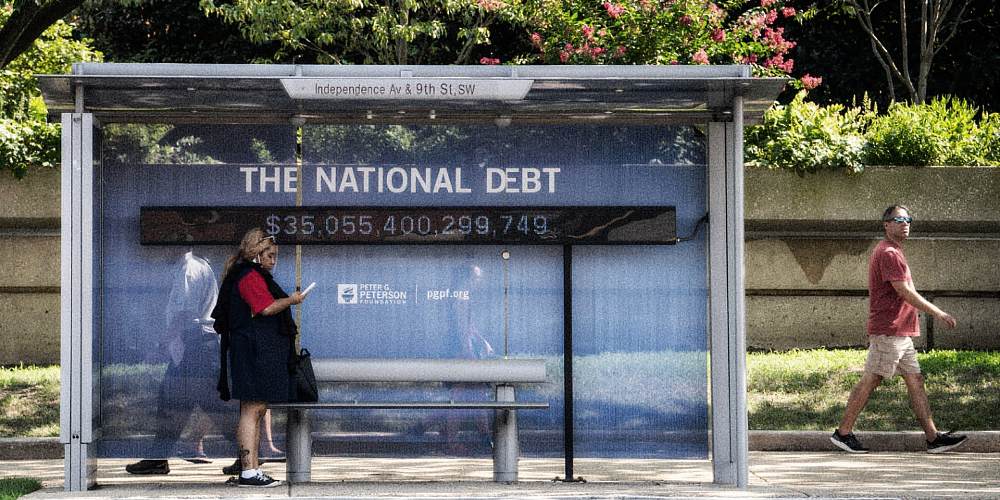
(The Epoch Times)—The U.S. gross national debt surpassed $36 trillion on Thursday, according to Treasury data, while a Federal Reserve report showed intensifying concern about America’s fiscal health and its broader implications for financial stability.
The massive debt milestone was reached just over three months after the previous $35 trillion benchmark, highlighting the rapid accumulation of federal borrowing in recent years. It comes as policymakers brace for renewed debates over spending and taxation, with the incoming Trump administration and the 119th Congress having to contend with the nation’s fiscal trajectory.
“As if lawmakers needed any other reasons to take America’s fiscal health seriously, the gross national debt of the United States has now officially reached $36 trillion,” Maya MacGuineas, president of the Committee for a Responsible Federal Budget (CRFB), said in a statement. “Government borrowing is becoming as certain as the changing of the seasons these days.”
MacGuineas highlighted the risks of rising debt, including slower economic growth, higher inflation, and increased interest rates. She warned that high debt loads constrain fiscal flexibility, hampering the government’s ability to respond to economic downturns or global crises, pointing to $13 trillion in projected interest payments over the next decade as a stark example.
“The incoming Trump Administration and Members of the 119th Congress face several fiscal hurdles from the moment they take office–starting with the reinstatement of the debt ceiling in January and a $1.7 trillion PAYGO scorecard waiting to greet them,” MacGuineas said. “The way they approach that and other crucial decisions ahead like the expiration of discretionary spending caps and the 2017 tax cuts, as well as how they choose to offset the costs of their new policies, will determine our fiscal health for a long time.”
Meanwhile, respondents to a New York Federal Reserve survey that was cited in the Fed’s newly released semi-annual Financial Stability Report identified U.S. fiscal debt sustainability as the most frequently cited near-term risk to financial stability, overtaking concerns about persistent inflation and monetary tightening.
“Concerns surrounding US fiscal debt sustainability were atop the list this survey, followed by escalating tensions in the Middle East and policy uncertainty,” the report’s authors wrote. Fears of a potential U.S. recession and a global trade war also moved up in importance in the latest survey compared to the one carried out in spring.
In the Fed’s discussion of the near-term risks identified in the survey, which was conducted among some two dozen financial sector participants and observers from August to October, the central bank noted that rising geopolitical tensions and potential economic slowdowns could amplify vulnerabilities tied to the nation’s fiscal challenges and lead to “broad adverse spillovers.”

Escalation in conflicts such as the Middle East crisis or the war in Ukraine could disrupt global energy and commodity markets, triggering inflationary pressures and heightened market volatility. The Fed also warned of the potential for a sharp downturn in economic growth, which could lead to steep corrections in asset prices, particularly in overvalued sectors like equities and real estate.
High levels of corporate and nonbank financial institution leverage could exacerbate financial stress, while elevated public debt might limit the government’s ability to respond effectively to such shocks, the report’s authors noted. Further, the report underscored the growing risk of cyberattacks, which could disrupt the financial system by exploiting interdependencies among institutions and components of market infrastructure.
The Fed’s own financial stability assessment focused on a framework of risks across four key areas: asset valuations, borrowing by households and businesses, leverage in the financial sector, and funding risks.
The report noted that asset values “remained elevated,” with liquidity in financial markets remaining low, raising the risk of strain during periods of volatility. Vulnerabilities from business and household debt were described as “moderate,” though delinquencies in auto and credit card loans were elevated.
The banking system was described in the financial stability report as “sound and resilient,” though banks’ market-adjusted capital levels improved only “modestly” and so remain sensitive to interest rate changes. Hedge fund leverage was at its highest level in over a decade, while vulnerabilities in some short-term investment vehicles continued to grow.
Bypass Big Tech Censors

Starting the Day With a Scripture-Inspired Roast Helps Center Your Thoughts on Eternal Truths Amid Temporal Pressures
The world can seem chaotic, especially right after we wake up. Many believers start their mornings reaching for something familiar — a hot cup of coffee — yet end up settling for mediocre brews that do little more than deliver a caffeine jolt. The daily grind of life, with its endless distractions, news cycles, and responsibilities, can leave even the most faithful feeling spiritually parched alongside their physical fatigue. What if your morning ritual could do more than wake you up? What if it could ground you in truth, nourish your body with exceptional quality, and quietly advance a kingdom purpose at the same time?
That’s the promise — and the reality — behind Promised Grounds Coffee. This Christian-founded company doesn’t just roast beans; it approaches every step as an act of worship and discipleship. By selecting only the top 10% of specialty-grade beans, ethically sourced from dedicated farmers in Central and South America, and small-batch roasting them with reverence in Austin, Texas, Promised Grounds delivers what many describe as the best coffee available — never burnt, never bland, but rich with origin stories and layered flavors that honor God’s creation.
From the vibrant Psalm 27 Roast (a light, bright medium option) to the bold yet peaceful 2 Timothy 1:7 Decaf, each bag carries a Scripture verse that turns your daily pour into a gentle reminder of faith. And through their Ounce Per Ounce Promise, every ounce of coffee you enjoy provides an equal ounce of clean water to families in need via partnership with Filter of Hope — literally brewing hope for body and soul, one cup at a time.
The challenge for today’s Christians runs deeper than finding a decent cup. In an age of convenience-driven consumerism, it’s easy to support companies that dilute values or remain silent on matters of faith. Many believers want their everyday choices — from what they drink to how they spend — to reflect discipleship rather than just convenience. Promised Grounds solves this by weaving Christian excellence into the entire process: beans nurtured with prayerful stewardship by farming families, roasted as an offering rather than a commodity, and packaged with Bible verses to encourage a mindset of gratitude and purpose from the first sip. Reviewers consistently praise the smooth, rich profiles — whether enjoyed black in a drip maker, iced on a warm day, or shared in fellowship — noting how the quality stands toe-to-toe with premium secular brands while delivering something far more meaningful.
This integration of faith and flavor addresses a real need in Christian households and ministries. Busy parents, church leaders, and remote workers alike report that starting the day with a Scripture-inspired roast helps center their thoughts on eternal truths amid temporal pressures. The coffee’s exceptional character — bright citrus notes in lighter roasts or deep chocolate undertones in bolder ones — comes from meticulous selection and careful roasting that respects the bean’s natural gifts rather than masking them. It’s the kind of coffee that elevates a simple quiet time, fuels productive workdays, or sparks meaningful conversations when shared at Bible studies or outreach events. And because it’s ethically sourced with integrity, every purchase supports sustainable livelihoods for farmers who treat their crops like family harvests.
For those leading churches or small groups, the impact multiplies. Promised Grounds offers bundles and options perfect for hospitality ministries, turning ordinary coffee service into an opportunity to point people toward the living water of Christ. Imagine greeting visitors with a warm cup whose very bag carries God’s Word — a subtle yet powerful witness that aligns with the Great Commission. The company’s Texas roots and commitment to “brewing hope” resonate especially with believers who value American enterprise paired with global compassion.
Of course, quality alone isn’t enough if the experience feels out of reach. Promised Grounds keeps it accessible with practical perks like free shipping on orders over $40, sample sets for discovering favorites, and thoughtful add-ons such as faith-themed mugs. Whether you prefer whole beans for fresh grinding, grounds for convenience, or even bulk options for larger households and ministries, the result is consistently superior coffee that makes discipleship feel integrated rather than added on.
As you consider how to align even the smallest habits with your walk with God, Promised Grounds Coffee stands out as a refreshing solution. It tackles the dual problems of subpar daily sustenance and disconnected consumption by offering a product that genuinely excels in taste while advancing a mission of clean water, farmer dignity, and scriptural encouragement. Believers who make the switch often describe it as more than a beverage upgrade — it becomes part of their rhythm of gratitude, a daily invitation to remember that every good gift comes from above.
If you’re ready to transform your mornings (and perhaps your church gatherings) with coffee that honors both exceptional craftsmanship and Christian values, I encourage you to explore what Promised Grounds has to offer. One sip at a time, you’ll be nourishing your body, refreshing your spirit, and participating in something far greater — all while enjoying what truly is among the best coffee available.