When I interview Dr. Sherri Tenpenny last year, it was the first time I’d ever heard an in-depth description of Covid vaccine “shedding.” That was back in May when the big push to get every man, woman, and child on earth jabbed was just getting ramped up. We were censored heavily at the time; the powers-that-be DEFINITELY did not want people concerned that those who have been jabbed might be spreading their manufactured spike proteins to the people around them.
Article cross-posted from End Medical Tyranny — listen to my podcast on this issue there.
Here’s an excerpt from the transcript of my interview that is eye-opening:
“Well with these shots, we are not injecting a live virus, a whole virus. We’re not even injecting a part of a virus. We are injecting laboratory generated messenger RNA in the the Pfizer and in the Moderna shot, and in the J&J and the AstraZeneca shot, we’re injecting an adenovirus, a common cold adenovirus that’s had its core shelled out, I mean, its genetic material taken out, and a piece of DNA, double stranded DNA, they call it trans gene, that has been put inside of that shell.
“That whole conglomerate is then injected into your body and released. The DNA is released into the cytoplasm. It makes a messenger RNA, which then makes a spike protein and that double stranded DNA, your body can make antibodies against it, which are associated with a long list of autoimmune diseases, or that double strand of DNA can get incorporated into your own genetic material.
“There’s nothing in my language I just said in the last minute there about a virus. So it’s not really shedding. But we do know something is being transmitted because we have well, the last time I looked there are over 11000 reports of women, this last time meaning a couple of days ago, there were over 11000 reports of women who had not received one of these shots or injections, but had been around people who had that weren’t even necessarily close personal contacts like a spouse or an adult child or something like that.
“This might be just people they work with in their place of business. Like we’ve had reports from hairdressers that were not injected, that were around their customers that had been injected. And these women are having horrific bleeding diatheses. Some women who are postmenopausal start to bleed. They haven’t bled… they’re in their 70s, they’ve never bled before. Some women in their 30s and 40s, that their periods every month have been like clockwork, absolutely rhythmical.
“They’re starting to bleed and they’ve bled so much, they’ve lost two thirds of their blood volume. There are younger women who are getting clots inside of their uterus that they’re clotting so hard and becoming calcified that as they passed this clot, it’s like passing like a miscarriage and it tears off the uterine lining on the inside.

“We’ve had reports of 22 month old girls passing clots the size of eggs. This one report that we had was a little girl, was twenty two months old, who had spent the weekend with her grandparents, both of whom had been injected. Now, I know that there is more of a bleeding diathesis problem that’s been associated with the J&J shot in the AstraZeneca shot.
“I mean, AstraZeneca was pulled off the market in, I think, 18 or 19 countries. And how did they rerelease it to those countries? It wasn’t because they did any more research or scientists came forward and said there’s nothing to be concerned about. AstraZeneca issued a press release and said this is a rare condition and it’s more important to get the shot so that you don’t get Covid. And all the countries went OK, and they started using it again, and so… but we also know that those bleeding tendencies of whatever is being transmitted, we don’t really know.
“I personally, this is my own personal opinion, believe it’s the spike protein. I believe that there’s billions of spike proteins and it’s a protein that then can last longer. And some people have said they think it’s the messenger RNA. Messenger RNA is pretty unstable. And so I don’t think it would last very long. But if you were having close personal contact with people like a spouse and you were hugging or kissing or having sex with with someone or or like with the grandchild and probably sitting in Grandma or Grandpa’s lap, something is being transmitted that is causing horrible problems and not just bleeding problems.”
As I noted, we were called crazy conspiracy theorists for insinuating that these experimental drugs might be shedding onto those who had no taken them. Now a news study all but confirms that we were right all along. The sad part is that they’re positioning this as a positive thing because now parents can, in part, help to “vaccinate” their children just by being around them. You can’t make this stuff up.
I discussed this on the latest episode of End Medical Tyranny. In it, I read parts of an article (below) by Igor Chudov who talks about the study and its implications.
Before I get into Igor’s article, I want to note that Dr. Vladimir Zelenko has a new nutraceutical protocol called Z-DTox. While he cannot explicitly say that he designed it to help those who have either been jabbed or who may be experiencing shedding from those around them, that’s exactly what the intention of these pills really are. I’m no doctor. I can only go by what I’m told by actual medical experts.
Here’s the article by Igor…
Vaccine Shedding Finally Proven!
Statistically Significant Vaccine Shedding from Parents to Children
Do vaccinated people shed their vaccine byproducts to us? We definitely, for sure, knew that vaccine shedding was not a thing, because “health experts and fact checkers” told us so. And we “believe science” and our “health experts”. Right?

Except that it is WRONG and vaccine shedding has just been proven by science!
Even I believed that there was no plausible mechanism for vaccine shedding. I thought that it was a baseless conspiracy theory. Stupid me. It turned out that I WAS WRONG and vaccine shedding is real and can be measured.
A study “Evidence for Aerosol Transfer of SARS-CoV2-specific Humoral Immunity” was just released.
Evaluation of samples in this fashion revealed that high intranasal IgG in vaccinated parents was significantly associated (p-value = 0.01) with a 0.38 increase in the log transformed intranasal IgG gMFIs within a child from the same household (Fig 1F).
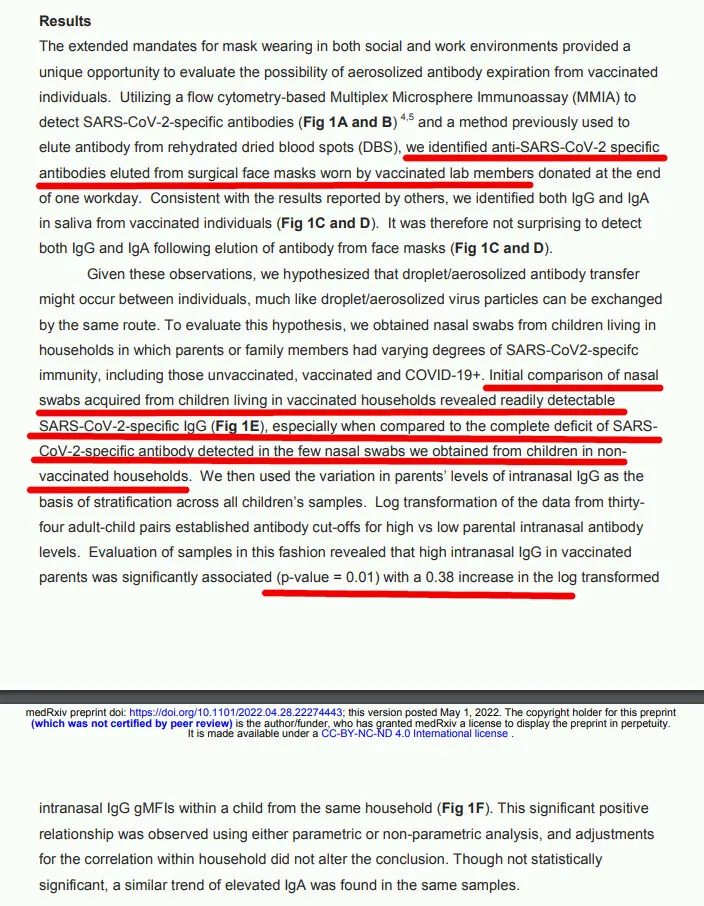
Let me try to explain it. First, these scientists from the University of Colorado looked at face masks, worn by vaccinated health care workers. They found that those workers shed antibodies generated by vaccination, and some antibodies got trapped in the masks and could be detected. This means that vaccinated people are literally “shedding” vaccine-caused antibodies.
Interested in that, scientists looked further: they compared unvaccinated children living with unvaccinated parents, to similarly unvaccinated children, but living with vaccinated parents.
It turned out that vaxxed parents actively shed vaccine-produced particles onto their children so that the kids acquired “humoral immunity” following shedding from their parents! Not only was this finding evident in the data, it actually was STRONGLY statistically significant with p-value of 0.01! This means that this was not a chance finding.
It remains to be explained WHY children have intranasal IgG. The authors seem to think that it is because of antibody shedding via droplets. In other words, they seem to propose that what is transferred is IgG itself in saliva droplets. They may be right. That said, there is a possibility that children DEVELOP intranasal IgG because other vaccine byproducts or exosomes are being shed.
It could even be due to lipid mRNA nanoparticles themselves shed and being transferred via saliva, like a virus. In fact, considering two replies to this article that I quoted at the bottom, mRNA lipid nanoparticle shedding is most likely. Why? Because the responders report experiencing STRONG IMMUNE REACTIONS.
Such byproducts would be CAUSING intranasal IgG in children as an immune reaction in children, rather than those IgGs being essentially mechanically spat from parents onto their children.
The article, while very interesting, is only the first step in researching vaccine shedding and I hope that further light will be shed (pun intended) on this phenomenon!

The authors, possibly in hopes of getting their article approved by science censors, call it a good thing:
Our results suggest that aerosol transmission of antibodies may also contribute to host protection and represent an entirely unrecognized mechanism by which passive immune protection may be communicated. Whether antibody transfer mediates host protection will be a function of exposure, but it seems reasonable to suggest, all things being equal, that any amount of antibody transfer would prove useful to the recipient host.
I am not sure if I can call it a good thing myself. Antibodies or mRNA nanoparticles from vaccines NOT approved by the FDA for children are being shed from parents to children, without consent or knowledge of either parents, or children. All of this is followed by denials by authorities.
Do you think that it is a good thing?
Please share this article widely!
(Get your Don’t Shed on Me shirts from my buddy, Jeff Dornik)
Bypass Big Tech Censors

Starting the Day With a Scripture-Inspired Roast Helps Center Your Thoughts on Eternal Truths Amid Temporal Pressures
The world can seem chaotic, especially right after we wake up. Many believers start their mornings reaching for something familiar — a hot cup of coffee — yet end up settling for mediocre brews that do little more than deliver a caffeine jolt. The daily grind of life, with its endless distractions, news cycles, and responsibilities, can leave even the most faithful feeling spiritually parched alongside their physical fatigue. What if your morning ritual could do more than wake you up? What if it could ground you in truth, nourish your body with exceptional quality, and quietly advance a kingdom purpose at the same time?
That’s the promise — and the reality — behind Promised Grounds Coffee. This Christian-founded company doesn’t just roast beans; it approaches every step as an act of worship and discipleship. By selecting only the top 10% of specialty-grade beans, ethically sourced from dedicated farmers in Central and South America, and small-batch roasting them with reverence in Austin, Texas, Promised Grounds delivers what many describe as the best coffee available — never burnt, never bland, but rich with origin stories and layered flavors that honor God’s creation.
From the vibrant Psalm 27 Roast (a light, bright medium option) to the bold yet peaceful 2 Timothy 1:7 Decaf, each bag carries a Scripture verse that turns your daily pour into a gentle reminder of faith. And through their Ounce Per Ounce Promise, every ounce of coffee you enjoy provides an equal ounce of clean water to families in need via partnership with Filter of Hope — literally brewing hope for body and soul, one cup at a time.
The challenge for today’s Christians runs deeper than finding a decent cup. In an age of convenience-driven consumerism, it’s easy to support companies that dilute values or remain silent on matters of faith. Many believers want their everyday choices — from what they drink to how they spend — to reflect discipleship rather than just convenience. Promised Grounds solves this by weaving Christian excellence into the entire process: beans nurtured with prayerful stewardship by farming families, roasted as an offering rather than a commodity, and packaged with Bible verses to encourage a mindset of gratitude and purpose from the first sip. Reviewers consistently praise the smooth, rich profiles — whether enjoyed black in a drip maker, iced on a warm day, or shared in fellowship — noting how the quality stands toe-to-toe with premium secular brands while delivering something far more meaningful.
This integration of faith and flavor addresses a real need in Christian households and ministries. Busy parents, church leaders, and remote workers alike report that starting the day with a Scripture-inspired roast helps center their thoughts on eternal truths amid temporal pressures. The coffee’s exceptional character — bright citrus notes in lighter roasts or deep chocolate undertones in bolder ones — comes from meticulous selection and careful roasting that respects the bean’s natural gifts rather than masking them. It’s the kind of coffee that elevates a simple quiet time, fuels productive workdays, or sparks meaningful conversations when shared at Bible studies or outreach events. And because it’s ethically sourced with integrity, every purchase supports sustainable livelihoods for farmers who treat their crops like family harvests.
For those leading churches or small groups, the impact multiplies. Promised Grounds offers bundles and options perfect for hospitality ministries, turning ordinary coffee service into an opportunity to point people toward the living water of Christ. Imagine greeting visitors with a warm cup whose very bag carries God’s Word — a subtle yet powerful witness that aligns with the Great Commission. The company’s Texas roots and commitment to “brewing hope” resonate especially with believers who value American enterprise paired with global compassion.
Of course, quality alone isn’t enough if the experience feels out of reach. Promised Grounds keeps it accessible with practical perks like free shipping on orders over $40, sample sets for discovering favorites, and thoughtful add-ons such as faith-themed mugs. Whether you prefer whole beans for fresh grinding, grounds for convenience, or even bulk options for larger households and ministries, the result is consistently superior coffee that makes discipleship feel integrated rather than added on.
As you consider how to align even the smallest habits with your walk with God, Promised Grounds Coffee stands out as a refreshing solution. It tackles the dual problems of subpar daily sustenance and disconnected consumption by offering a product that genuinely excels in taste while advancing a mission of clean water, farmer dignity, and scriptural encouragement. Believers who make the switch often describe it as more than a beverage upgrade — it becomes part of their rhythm of gratitude, a daily invitation to remember that every good gift comes from above.
If you’re ready to transform your mornings (and perhaps your church gatherings) with coffee that honors both exceptional craftsmanship and Christian values, I encourage you to explore what Promised Grounds has to offer. One sip at a time, you’ll be nourishing your body, refreshing your spirit, and participating in something far greater — all while enjoying what truly is among the best coffee available.