The most important lesson I’ve learned in life is this: Virtue matters. You cannot hope to find happiness until you accept that there are good and bad ways to live. For most of America’s history, these statements would have been considered common sense.
The cultural revolutions of the ‘60s and ‘70s changed so much about the structure of society. Relations between men and women changed. As women pursued careers, office culture changed. Family life changed. Public expressions of shared Christian beliefs slowly disappeared. Adults stopped acting as adults. Society embraced infantilism.
Out of this cultural conflagration, society abandoned any commitment to moral commandments. In the past, people understood that there were moral and immoral ways to behave. Poor decisions engendered social stigmatization, which produced feelings of personal shame, which encouraged reflection, self-corrective behavior, and future temperance. After the twentieth century’s cultural revolutions, morality was mocked as an outdated system of social control. Our institutions — including our churches — increasingly embraced the deception that extolling virtue and condemning sin was an impermissible sin of its own.
The end result has been a sixty-year walk toward nihilism, self-gratification, cynicism, amorality, emptiness, listlessness, and existential dread. All these descriptive nouns evoke torments one might endure in Hell. By refusing to admit that there are good ways and bad ways to live, our society has invited the Devil to remake the world in his image. Then our civic leaders feign surprise when it turns out that this is not a happy place to call home.
I want to make two arguments here: First, Americans will not succeed in the decades to come if they do not recommit to the pursuit of virtuous lives. Second, the United States will not succeed in the decades to come if its leaders continue to embrace moral equivocation over righteous truth-telling.
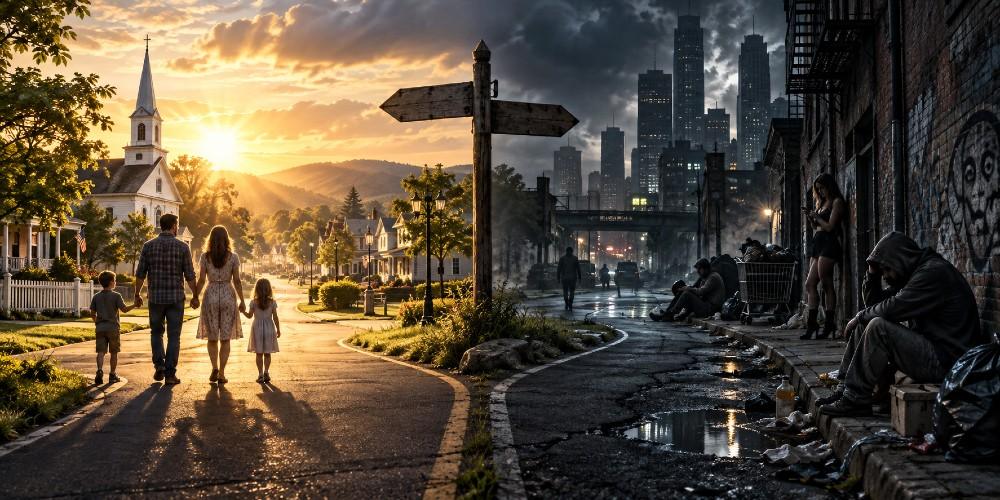
As to the first point, one need not look very hard to witness the devastating consequences for a society that abandons virtue and embraces sin. By treating addictions as psychological conditions beyond the reach of moral judgment, we have absolved addicts of any moral agency. As a consequence, every American city now “tolerates” entire neighborhoods where vagrants publicly drink, shoot up, fornicate, and defecate in the streets.
Not only is the recreational use of marijuana legal in much of the country but also it has become “politically incorrect” to judge people who depend upon cocaine, heroin, and other opiates to “function” in their daily lives.
Tens of millions of Americans are using a combination of prescription medicines, pot, alcohol, and illicit drugs that affect their states of mind. A steady decrease in Americans’ regular church attendance has been inversely proportional to Americans’ steady increase in mental health treatment. Because medical professionals have been taught that there are pharmacological therapies for every illness, patients now spend decades of their lives on pharmaceutical drugs. Social consciousness is hazy because members of society do not think clearly.

A natural repercussion of society’s “toleration” for drug addiction has been the normalization of broken families. Long gone are the days when an out-of-wedlock pregnancy would have brought a sense of shame and perhaps a hastily arranged marriage (at the shotgun-toting future father-in-law’s insistence). The Sexual Revolution of the ‘60s ushered in an era of libertinism, and the Supreme Court’s 1973 decision in Roe v. Wade to treat the killing of a baby as a woman’s constitutional right supercharged that libertinism.
As sex was decoupled from procreation and promiscuity supplanted chastity, the ancient bonds of marriage lost much of their meaning. In a society that glorifies pleasure over sacrifice and self-gratification over commitment, marriage has become an object of derision, while divorce has become something to celebrate as an act of “liberation.”
A society that mocks marriage and condones the murder of children produces fewer stable, healthy families. That statement is obvious yet rarely articulated out loud. A child growing up in a home with a mother and father is significantly more likely to become a healthy and successful adult. Married moms and dads are absolutely the best “medical treatment” a child could be prescribed.
Instead of recognizing the salubrious domino effect of healthy marriages and strong families on every subsequent generation, our society celebrates “hook-up” culture, single parenting, and the idea that lifetime commitments should be discarded whenever they get tough.
Fifty years of this destructive social philosophy has produced an epidemic of loneliness. Many women who chose to enjoy their sexual liberation sacrificed the support of a husband and the blessings of motherhood for a party that is much less fun after the age of forty. Many men who gave up on the institution of marriage sacrificed the support of a wife and the sense of purpose that a family provides. Many children who had no choice in the matter grew up to be dysfunctional — or even menaces to society — because they received too little discipline, direction, love, or some combination of all three.
As a result, everybody is now in therapy. It turns out that life without family or God is detrimental to one’s mental health.
Whether seen through the prisms of inebriation, selfishness, or debauchery, living a life devoid of virtue invariably leads to hopelessness. The wages of sin is death.
Just as too many Americans will fail to find happiness unless they recommit themselves to living well, our country will fail to endure unless its leaders find the strength to promote virtue and condemn wickedness. That is another obvious statement rarely articulated publicly.
A society that demonizes hard work, skill, and merit as forms of “white supremacy” while giving special privileges to people because of their skin color replaces true virtue with fake virtue. Societies that celebrate “victimhood” manufacture victims.
Nations filled with “victims” can never be victorious. Until America’s leaders stop obsessing over historical grievances, they will deprive each generation of the skills necessary for future success. “Political correctness” is not a virtue. Racial grievance is not a virtue.
“Transgenderism” or sexual fetishization is not a virtue. Unlawful residence in the United States is not a virtue. Diligence, temperance, patience, and humility are virtues. America will not survive unless its leaders are willing to acknowledge these truths.
I know what you’re thinking: American leaders never tell the truth. High-ranking members of the FBI and CIA lied about President Trump colluding with the Russians. Fifty-one members of the so-called “Intelligence Community” lied about Hunter Biden’s incriminating laptop being a “Russian information operation.”

Our federal government has been lying about the security of our borders for fifty years, while allowing tens of millions of foreign nationals to steal taxpayer dollars. Our election officials continue to lie about the prevalence of vote fraud in America, including a 2020 mail-in-ballot monstrosity that inexplicably made perennially unpopular Joe Biden the “most popular” politician in American history.
Our public health officials lied about COVID’s origins, the efficacy of masks, the need for school and business closures, and the safety of the experimental “vaccines.” Trust in corporate news media has never been lower. Fake Christians celebrate “Pride Month,” “transgenderism,” and even political assassination. The lies never stop; they just pile up, which is why a record 89% of Americans say that government corruption is widespread.
American institutions will not survive this level of public distrust. The lies and systemic fraud will sink them. American leaders will never reclaim any semblance of moral authority until they at least outwardly behave as moral individuals.
You cannot embrace sin and vice and expect people to follow you. You cannot inspire courage by being a coward. You cannot build a strong society atop a foundation of cultural weakness. For America to be great again, Americans must first remember how to be good. Virtue matters.
Bypass Big Tech Censors
Two Storms, One Harvest

Every food crisis in living memory has been a one-shock event. The 2008 price spike was a commodity bubble. The 2020 shortages were a logistics failure. The 2022 grain scare was a war on one exporter’s ports. Each time, the system bent, adjusted, and recovered, and each time the experts assured us afterward that global markets are simply too big and too diversified to fail.
What nobody in Washington seems eager to discuss is that 2026 is shaping up to be something the modern food system has never actually faced. Two independent shocks, one climatic and one geopolitical, are converging on the same harvest cycle at the same time. Not sequentially. Simultaneously.
Start with the weather. The Pacific Ocean is currently building toward what forecasters now openly call a record event. NOAA’s Climate Prediction Center puts the odds of at least a strong El Niño near 88 percent, with roughly two in three odds it reaches “very strong” status, the tier reserved for perhaps three or four events in the entire satellite era. Every major global model now projects a median peak in Super El Niño territory, and most of them project it exceeding the 2015-16 event, which until now held the modern record. Sea surface anomalies were already brushing the super threshold in mid-July, months before these events normally peak. The atmosphere has already shifted into El Niño mode, and the event is forecast to crest in late fall and early winter.
This is not about “climate change.” It’s about the standard cycles of weather, and the cycle we’re currently in is one that has likely devastated societies in the past. We’re better prepared as a society today, but not all Americans are equally prepared.
Serious households have started doing the quiet math on their own. Grocery bills tell part of the story, and the forecast maps tell the rest, which is why long-term food storage has moved from fringe hobby to mainstream line item in the family budget, with established suppliers like Heaven’s Harvest seeing demand from people who five years ago would have rolled their eyes at the idea. That instinct is not paranoia. It is pattern recognition, and the pattern is worth walking through carefully.
Editor’s Note: Heaven’s Harvest IS a sponsor, but the warnings of this article are real and would be written even if we didn’t have a survival food sponsor. With that said, those who take advantage of what they offer can use promo code “Patriot” for 15% off.
The Fertilizer Clock Is Already Running
While the Pacific warms, the second shock has been unfolding in the Strait of Hormuz. The conflict with Iran turned the world’s most important energy chokepoint into a contested waterway, and the consequences reach far beyond the gas pump. Roughly a third of global fertilizer trade moves through Hormuz, and the disruption sent urea prices up 86 percent year over year by March, with a 53 percent jump in a single month.
The World Bank projects energy prices rising about 24 percent in 2026 and fertilizer about 31 percent. By its own accounting, fertilizer prices ran 35 percent higher in the first five months of this year than the same period last year.
Here is the mechanism the nightly news will not explain. Fertilizer is not a grocery item. It is a time-delayed input. The nitrogen a farmer in Iowa or Punjab could not afford to apply this spring does not show up as a problem this spring. It shows up as a thinner harvest six to twelve months later.
The World Bank’s own food security brief concedes that the effects of reduced applications earlier this season “are likely to become visible only later in harvest outcomes.” Translate that from institutional language into plain English and it means this. The damage is already done, it is already in the ground, and we are simply waiting for it to arrive on the shelf.
Now check the calendar. Six to twelve months from the spring planting season lands us squarely in late 2026 and early 2027. Which is precisely when the strongest El Niño in the instrumental record is forecast to peak, bringing its signature droughts to Southeast Asia, Australia, southern Africa, northern Brazil, and South Asia, the very regions that grow the world’s rice, sugar, and oilseeds.
The World Bank warns openly that a strong El Niño “could disrupt multiple crop belts simultaneously” on top of the conflict-driven input costs. Their baseline projection assumes the Middle East disruptions ease by autumn. What in the last two years of Middle East history suggests that assumption is safe?
The System Has No Slack Left
The comfortable answer is that global markets always adjust. But adjustment requires slack, and the slack is gone. Global cereal production is expected to decline from last year’s records even before El Niño does its work. The UN World Food Programme, hardly a den of right-wing preppers, is calling this the most significant disruption to its supply chains since Covid and the invasion of Ukraine, and its supply chain director put the stakes bluntly.
Today’s supply chain challenges are tomorrow’s hunger crisis.
There is also a political dimension that markets cannot price. When food gets scarce, governments do not behave like economists. They behave like politicians. Export bans, hoarding mandates, and panic buying at the national level turned the modest rice shortfall of 2008 into a global crisis, and analysts are already warning that import-dependent nations are the first dominoes.
The 2015-16 Super El Niño, a far weaker event than what is now forecast, threw tens of millions into food stress across Africa and Asia. This one is projected to be stronger, and it arrives with fertilizer already rationed by price and shipping lanes already contested by missiles.
What Joseph Knew
Scripture does not treat preparation for lean years as faithlessness. It treats it as wisdom delivered in advance to those willing to act on it.
Behold, there come seven years of great plenty throughout all the land of Egypt: And there shall arise after them seven years of famine; and all the plenty shall be forgotten in the land of Egypt.
Joseph did not respond to that warning with a hashtag or a committee. He stored grain during the years of abundance, and when the famine came, Egypt stood while its neighbors begged. The lesson is not that famine is certain. It is that the time to prepare is precisely when preparation still looks optional.
Nobody who filled a pantry in a year of plenty has ever regretted it, and nobody standing in an empty aisle has ever been glad he waited for certainty.
None of this calls for panic, and panic is the enemy of sound judgment anyway. It calls for the same unglamorous prudence our grandparents considered ordinary. Keep some cash margin, know your local growers, and put real food in deep storage while it is cheap and available, because the entire arc of this story is that cheap and available is a closing window.
Families looking for a straightforward place to start can visit Heaven’s Harvest and use promo code Patriot for 15 percent off long-term storable food. The forecasts may yet soften, the strait may yet reopen, and we should pray they do. But hope is a fine thing to hold and a foolish thing to eat.