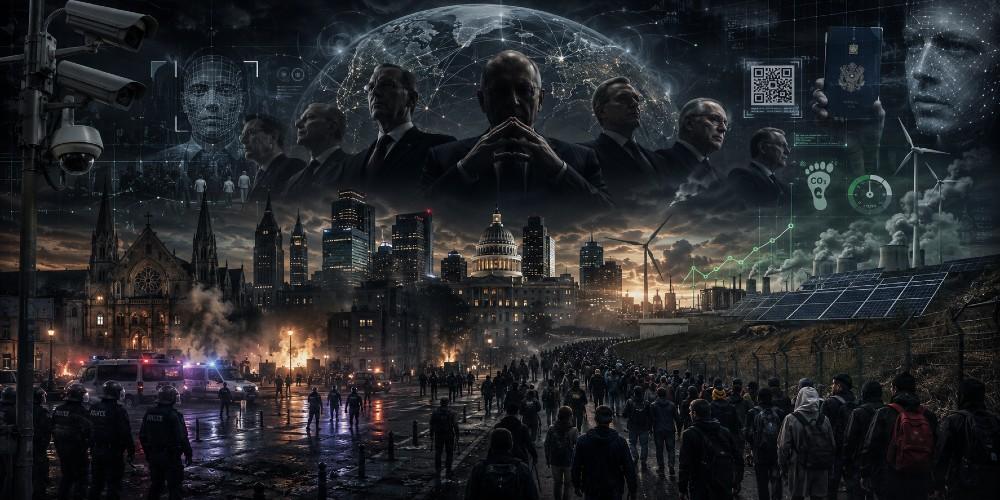
The global managerial class of bureaucrats, bankers, politicians, corporate heads, and NGOs are committed to fomenting chaos and violence in Western nations. In the name of fighting the imaginary “climate change” hobgoblin, they outlaw inexpensive forms of energy and push us toward a carbon-tracking system that justifies ever more intrusive forms of mass surveillance.
In the name of fighting exotic pandemics, they justify mass lockdowns, central bank digital currencies, and “vaccine” passports. By claiming that man-made “climate change” causes new pandemics and by blaming Western industrialized societies for causing “climate change,” the global managerial class insists that Western nations must accept “climate refugees” as part of their rolling atonement for past industrial “sins.”
It’s all excrement-laden propaganda disguised as “science” and “virtue.” Even worse, all these risible lies represent a sustained attack on Western peoples. Consider how malicious these globalists really are: They have spent at least the last half-century scaring children into believing that modern industry is imminently killing the planet. We have been inundated with so much “global warming/cooling/climate change/extreme weather” mass hysteria for so long that we no longer recognize how absolutely evil these enviro-fascist, nut-job propagandists are.
If a stranger came to our homes, absconded with our children, and spent the next fifteen years brainwashing them to believe that the world was coming to an end, we would be horrified. We would call the kidnappers “child abusers” and “monsters.” We would do everything we could to heal the minds of our troubled children. Yet in elementary school classrooms in Canada, Australia, the United Kingdom, the United States, and across the European Union, little kids are conditioned to believe in the lie that innovation, productivity, material wealth, and industry are poisons that will kill them all. It’s insane. And it’s even more insane that we let it happen.
The “climate change” con is big business. Crony capitalism works best when authoritarian governments mandate that everybody purchase windmills, solar panels, energy-efficient this, net-zero-modulated that. When politicians and bureaucrats make it prohibitively expensive for small companies to produce anything, Big Business obtains a government-regulated monopoly over entire industrial sectors. Those corporate monopolies kick back a chunk of the loot to the politicians, regulators, and NGOs, and all the money-making conspirators stay rich and happy.
Who loses? The free market loses. When only big corporations can afford to make things, innovation in Europe resembles that of Africa. Ordinary citizens lose because they are effectively blocked from using their brainpower and muscle-power to build and sell new things that generate income, capital, and social mobility. Society loses because the marketplace of ideas turns into a centrally-managed cartel run by a couple of multinational investment houses.
Who wins? The global managerial class wins. All these central managers who are committed to tracking and tracing our every movement and thought depend upon a global system that turns carbon-based human beings who exhale carbon-bonded molecules with each breath into accounting units that must be managed, programmed, and controlled as part of globalism’s unspoken social contract imposed upon citizens for the “privilege” of living.
Communists, fascists, and sundry sordid authoritarians of the world have united under the banners of “net-zero” initiatives and “saving the planet” exhortations because “saving the planet” gives them an excuse to monitor, punish, and even eliminate you.

After all, how “selfish” must one person be to believe that his wants and needs are more important than “saving the planet” from destruction? Totalitarianism thrives on fairytales that teach the value of working for “the greater good,” and every one of those fairytales is inherently murderous. For the sake of the “collective,” the “green new deal” fanatics believe that some people must die! They won’t be the ones volunteering to jump into the volcano or be sacrificed on the Mayan temple. They will choose the “nonbelievers” for the coming “net-zero” bloodletting.
And that bloodletting has already begun! How in the world could a sane person justify moving millions of military-aged men from third-world hellholes into advanced Western nations? There is nothing about mass migration that makes sense if the goal is to make host nations stronger.
The people being dropped off in the United States and Europe have no skills or education. They do not speak English, French, Swedish, Danish, Polish, Italian, Spanish, or German. They have no interest in learning those languages. They have no interest in assimilation. They prefer to take over historic villages, overwhelm the schools, turn Christian churches into mosques, transform downtown shops into foreign enclaves and black-market hubs, rape the locals, and drain the taxpayer-funded social safety net. Just as parasites feed on weakened hosts until ultimately killing them, invading armies of foreign nationals are devouring enfeebled Western nations until delivering their final death blows.
None of this is “politically correct” to say out loud, of course. Our global managerial class has spent the last thirty years drumming into our brains the nonsensical refrain, “Diversity is our strength!” “Multiculturalism” — the simultaneous existence of many different cultures — is supposed to be superior to any one single culture.
How does that make any sense? Is it easier for a general to command troops if all the soldiers speak different languages? Is there less chance of mutiny on a naval vessel if every sailor adheres to different customs? Does a religious temple serve a purpose if all the congregants pray to different gods? Of course not. Without common cultural bonds, human beings rarely work well together.
Why, then, should Western nations be transformed into meccas for multiculturalism? Why in the world would a rational person celebrate the transformation of European and American cities into “no-go zones” where tribes of different peoples fight against each other for power and position?
Why are Western political parties demanding mass amnesty for millions of foreigners? How does any of this make any sense unless the intent is to destroy individual Western nations?
And if Western nations are under attack, does it not seem reasonable for Western citizens to prepare to defend themselves? Vice President Vance thinks Westerners should be doing exactly that. After a man from a foreign culture brutally murdered British university student Henry Nowak, Vance condemned authorities’ calculated choice to sacrifice a native son on the altar of forced “diversity”:
Henry Nowak died the same way a civilization dies: abandoned, handcuffed by authorities who neither trusted nor cared for him, and accused of hate crimes he did not commit. His murder is as tragic as it is enraging. He should still be alive today, and he would be if the last few generations of European elites had stood their ground against the politics of self-hatred and the mass invasion of migrants, many of whom despise the West and the people who love it. Henry was far from the first to so needlessly lose his life, and I fear he won’t be the last. Each time a life like his is lost, the proper response — the only response — is righteous anger.
In the week since Nowak’s murderer was convicted, four Afghan migrants are facing prosecution in Bristol for raping a seventeen-year-old girl, there was a mass stabbing in Manchester, and a Sudanese national attempted to behead an Irishman in Belfast.
Does the British government still contend that “diversity is our strength”? Of course it does. Rather than blaming foreign nationals for murdering British citizens, the British Establishment is blaming British citizens for noticing that their nation is under attack.
The West is at war with foreign invaders, and Western governments are at war with imaginary “climate change.” New Western leaders must take over before there is no West left.
Bypass Big Tech Censors
Two Storms, One Harvest

Every food crisis in living memory has been a one-shock event. The 2008 price spike was a commodity bubble. The 2020 shortages were a logistics failure. The 2022 grain scare was a war on one exporter’s ports. Each time, the system bent, adjusted, and recovered, and each time the experts assured us afterward that global markets are simply too big and too diversified to fail.
What nobody in Washington seems eager to discuss is that 2026 is shaping up to be something the modern food system has never actually faced. Two independent shocks, one climatic and one geopolitical, are converging on the same harvest cycle at the same time. Not sequentially. Simultaneously.
Start with the weather. The Pacific Ocean is currently building toward what forecasters now openly call a record event. NOAA’s Climate Prediction Center puts the odds of at least a strong El Niño near 88 percent, with roughly two in three odds it reaches “very strong” status, the tier reserved for perhaps three or four events in the entire satellite era. Every major global model now projects a median peak in Super El Niño territory, and most of them project it exceeding the 2015-16 event, which until now held the modern record. Sea surface anomalies were already brushing the super threshold in mid-July, months before these events normally peak. The atmosphere has already shifted into El Niño mode, and the event is forecast to crest in late fall and early winter.
This is not about “climate change.” It’s about the standard cycles of weather, and the cycle we’re currently in is one that has likely devastated societies in the past. We’re better prepared as a society today, but not all Americans are equally prepared.
Serious households have started doing the quiet math on their own. Grocery bills tell part of the story, and the forecast maps tell the rest, which is why long-term food storage has moved from fringe hobby to mainstream line item in the family budget, with established suppliers like Heaven’s Harvest seeing demand from people who five years ago would have rolled their eyes at the idea. That instinct is not paranoia. It is pattern recognition, and the pattern is worth walking through carefully.
Editor’s Note: Heaven’s Harvest IS a sponsor, but the warnings of this article are real and would be written even if we didn’t have a survival food sponsor. With that said, those who take advantage of what they offer can use promo code “Patriot” for 15% off.
The Fertilizer Clock Is Already Running
While the Pacific warms, the second shock has been unfolding in the Strait of Hormuz. The conflict with Iran turned the world’s most important energy chokepoint into a contested waterway, and the consequences reach far beyond the gas pump. Roughly a third of global fertilizer trade moves through Hormuz, and the disruption sent urea prices up 86 percent year over year by March, with a 53 percent jump in a single month.
The World Bank projects energy prices rising about 24 percent in 2026 and fertilizer about 31 percent. By its own accounting, fertilizer prices ran 35 percent higher in the first five months of this year than the same period last year.
Here is the mechanism the nightly news will not explain. Fertilizer is not a grocery item. It is a time-delayed input. The nitrogen a farmer in Iowa or Punjab could not afford to apply this spring does not show up as a problem this spring. It shows up as a thinner harvest six to twelve months later.
The World Bank’s own food security brief concedes that the effects of reduced applications earlier this season “are likely to become visible only later in harvest outcomes.” Translate that from institutional language into plain English and it means this. The damage is already done, it is already in the ground, and we are simply waiting for it to arrive on the shelf.
Now check the calendar. Six to twelve months from the spring planting season lands us squarely in late 2026 and early 2027. Which is precisely when the strongest El Niño in the instrumental record is forecast to peak, bringing its signature droughts to Southeast Asia, Australia, southern Africa, northern Brazil, and South Asia, the very regions that grow the world’s rice, sugar, and oilseeds.
The World Bank warns openly that a strong El Niño “could disrupt multiple crop belts simultaneously” on top of the conflict-driven input costs. Their baseline projection assumes the Middle East disruptions ease by autumn. What in the last two years of Middle East history suggests that assumption is safe?
The System Has No Slack Left
The comfortable answer is that global markets always adjust. But adjustment requires slack, and the slack is gone. Global cereal production is expected to decline from last year’s records even before El Niño does its work. The UN World Food Programme, hardly a den of right-wing preppers, is calling this the most significant disruption to its supply chains since Covid and the invasion of Ukraine, and its supply chain director put the stakes bluntly.
Today’s supply chain challenges are tomorrow’s hunger crisis.
There is also a political dimension that markets cannot price. When food gets scarce, governments do not behave like economists. They behave like politicians. Export bans, hoarding mandates, and panic buying at the national level turned the modest rice shortfall of 2008 into a global crisis, and analysts are already warning that import-dependent nations are the first dominoes.
The 2015-16 Super El Niño, a far weaker event than what is now forecast, threw tens of millions into food stress across Africa and Asia. This one is projected to be stronger, and it arrives with fertilizer already rationed by price and shipping lanes already contested by missiles.
What Joseph Knew
Scripture does not treat preparation for lean years as faithlessness. It treats it as wisdom delivered in advance to those willing to act on it.
Behold, there come seven years of great plenty throughout all the land of Egypt: And there shall arise after them seven years of famine; and all the plenty shall be forgotten in the land of Egypt.
Joseph did not respond to that warning with a hashtag or a committee. He stored grain during the years of abundance, and when the famine came, Egypt stood while its neighbors begged. The lesson is not that famine is certain. It is that the time to prepare is precisely when preparation still looks optional.
Nobody who filled a pantry in a year of plenty has ever regretted it, and nobody standing in an empty aisle has ever been glad he waited for certainty.
None of this calls for panic, and panic is the enemy of sound judgment anyway. It calls for the same unglamorous prudence our grandparents considered ordinary. Keep some cash margin, know your local growers, and put real food in deep storage while it is cheap and available, because the entire arc of this story is that cheap and available is a closing window.
Families looking for a straightforward place to start can visit Heaven’s Harvest and use promo code Patriot for 15 percent off long-term storable food. The forecasts may yet soften, the strait may yet reopen, and we should pray they do. But hope is a fine thing to hold and a foolish thing to eat.