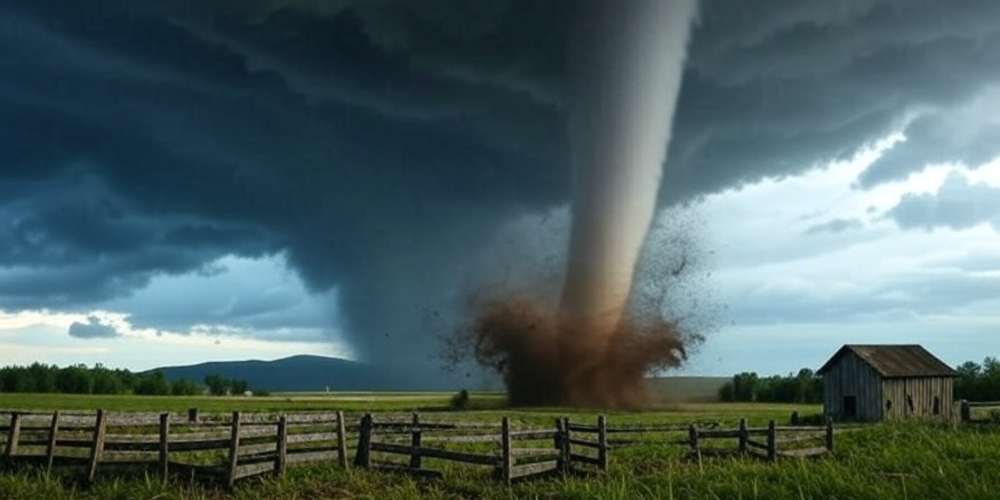
(End of the American Dream)—Have you noticed that America has been getting pummeled by a series of major natural disasters in recent days? Dozens of immensely powerful tornadoes have carved trails of destruction across the middle of the country, Chicago was just hit by an “apocalyptic” wall of dust, and a plague of millions upon millions of crickets is causing chaos in Utah. Some have pointed out that what we are currently going through is eerily similar to what the U.S. experienced during the days of the Great Depression in the 1930s.
Others are wondering if the weird behavior of the Sun has anything to do with the disasters that we are now seeing. But what everyone should be able to agree on is that what we are witnessing right now is certainly not normal.
Late last week, more than 70 tornadoes caused “catastrophic destruction” throughout the heartland of America…
At least 28 people have died and dozens more were injured after a devastating wave of severe weather swept across the central United States late Friday into Saturday, leaving a trail of catastrophic destruction.
More than 70 tornadoes, destructive hail, and powerful wind gusts caused damage across the middle of the country during the multiday severe weather outbreak that started Thursday, May 16.
The state of Kentucky was hit harder than anywhere else.
According to Accuweather, entire neighborhoods in the town of London were “reduced to piles of shredded wood and debris”…
Large tornadoes have been reported in Missouri, Kentucky, Illinois and Indiana with hard-hit southeastern Kentucky reporting a majority of the fatalities. According to Kentucky Governor Andy Beshear, there were 18 confirmed deaths in the state connected to the severe weather. The fatalities include 17 people in Laurel County and one in Pulaski County.
Images emerging at first light on Saturday from the town of London, about 75 miles south of Lexington, show entire neighborhoods razed with homes reduced to piles of shredded wood and debris, downed power lines, cars tossed all over the place and furniture strewn everywhere.
When those tornadoes first occurred, they made headlines all over the nation, but most Americans have completely forgotten about them by now.
But some of those communities in Kentucky will never recover from this.
St. Louis was also hit by an absolutely massive tornado on Friday.

That particular tornado had “maximum winds of 152 mph”, and it is being estimated that it caused about a billion dollars in damage…
A single tornado that marched through the St. Louis area on a path of 22.6 miles with maximum winds of 152 mph caused five deaths, a few dozen injuries and approximately $1 billion in damage Friday.
Mayor Cara Spencer gave the estimate of the damage at a Sunday news conference and said the recovery would be a long one. In a second news conference later in the day, she emphasized that financial donations were “badly needed.”
At this stage in our history, “billion dollar disasters” happen so frequently that nobody really gets too fired up about them anymore.
Last year, we experienced a “billion dollar disaster” about once every two weeks.
We are being told that conditions will “return to normal” eventually, but there is definitely nothing normal about what we have been experiencing over the past couple of years.
Just look at what just happened in Chicago. It is being reported that the Windy City just issued “the first dust storm warning ever”…
A dust storm that brought visibility to near zero swept across the Chicago area Friday, prompting the first dust storm warning ever issued to the city, officials said.
The “wall of dust” that struck the South Side and other areas occurred on a day in which high winds of 50 mph were forecast, and as a storm system caused at least one deadly tornado in Missouri.
The dust came in from the south, moving north, around 6:40 p.m. with winds of up to 60 mph, the National Weather Service said.
We haven’t seen anything quite like this since the Dust Bowl days.
On Friday, an “apocalyptic” wall of dust that slammed into Chicago was so large that it could literally be seen from space…
An apocalyptic ‘wall of dust’ is barreling across Chicago — so vast, it’s visible from space.
Satellite imagery shows the storm swallowing highways and buildings, plunging the city of 2.6 million people into darkness.
It has triggered visibility warnings, halted traffic, and left Chicago residents choking on dust.
When I first started warning that Dust Bowl conditions would be returning, a lot of people out there didn’t take me seriously.
But now gigantic dust storms have been hammering cities in the Midwest.
As the western half of the country continues to dry out, the gigantic dust storms will only get worse.
Following the chaos that we witnessed on Friday, 29 tornadoes touched down in five states on Sunday…
At least 29 tornadoes were reported across five states on Sunday, causing widespread damage in Colorado and Kansas. According to preliminary data, at least 16 tornadoes touched down in Kansas, 4 in Colorado, 4 in Oklahoma and Nebraska combined, and 1 in Texas.
Severe damage was reported in the community of Grinnell in Gove County, Kansas. Visuals of the storm’s aftermath showed destruction and damage to several structures, including homes and outbuildings.
The tornado blew the roof off the Catholic Church in Grinnell. Meanwhile, downed power lines caused closures on I-70, eastbound from Colby to Grinnell and westbound from Hays to Grinnell.
In the old days, the immense damage caused by these tornadoes would dominate the news cycle for weeks.

But most people will probably forget about these tornadoes by tomorrow.
We have become numb to the endless destruction that is happening all around us.
What is it going to take for people to start waking up?
How about a plague of millions upon millions of “cannibalistic insects”?…
Utah is under siege from a rapidly spreading infestation of Mormon crickets—cannibalistic insects that have returned in massive swarms.
In areas like Fillmore and Tooele, residents describe the invasion as ‘apocalyptic’, with bugs covering roads, fences, walls, and even the sides of homes.
Crushed crickets have made roads dangerously slick, leading to car accidents. In some counties, snow plows are being used to clear away tons of insects.
If you live in Utah, you will need to brace yourself for a long summer, because authorities are “warning that the worst may be yet to come”…
Farmers are already reporting early crop losses, and backyard gardens are being stripped overnight. In small towns, the air reeks of rotting insects.
Officials are warning that the worst may be yet to come. Eggs that hatched in spring could lead to a second wave of crickets by summer.
Throughout 2024 and 2025, the United States has been hit by major disasters again and again and again.

Sadly, hardly anyone seems to want to acknowledge that what we are experiencing is highly unusual.
There seems to be an overwhelming consensus that the period of extreme instability that we are currently witnessing is just temporary.
But what if it isn’t temporary?
We are being hit by one apocalyptic disaster after another, and I believe that what we have been through so far is just the beginning.
Michael’s new book entitled “10 Prophetic Events That Are Coming Next” is available in paperback and for the Kindle on Amazon.com, and you can subscribe to his Substack newsletter at michaeltsnyder.substack.com.
Bypass Big Tech Censors

Starting the Day With a Scripture-Inspired Roast Helps Center Your Thoughts on Eternal Truths Amid Temporal Pressures
The world can seem chaotic, especially right after we wake up. Many believers start their mornings reaching for something familiar — a hot cup of coffee — yet end up settling for mediocre brews that do little more than deliver a caffeine jolt. The daily grind of life, with its endless distractions, news cycles, and responsibilities, can leave even the most faithful feeling spiritually parched alongside their physical fatigue. What if your morning ritual could do more than wake you up? What if it could ground you in truth, nourish your body with exceptional quality, and quietly advance a kingdom purpose at the same time?
That’s the promise — and the reality — behind Promised Grounds Coffee. This Christian-founded company doesn’t just roast beans; it approaches every step as an act of worship and discipleship. By selecting only the top 10% of specialty-grade beans, ethically sourced from dedicated farmers in Central and South America, and small-batch roasting them with reverence in Austin, Texas, Promised Grounds delivers what many describe as the best coffee available — never burnt, never bland, but rich with origin stories and layered flavors that honor God’s creation.
From the vibrant Psalm 27 Roast (a light, bright medium option) to the bold yet peaceful 2 Timothy 1:7 Decaf, each bag carries a Scripture verse that turns your daily pour into a gentle reminder of faith. And through their Ounce Per Ounce Promise, every ounce of coffee you enjoy provides an equal ounce of clean water to families in need via partnership with Filter of Hope — literally brewing hope for body and soul, one cup at a time.
The challenge for today’s Christians runs deeper than finding a decent cup. In an age of convenience-driven consumerism, it’s easy to support companies that dilute values or remain silent on matters of faith. Many believers want their everyday choices — from what they drink to how they spend — to reflect discipleship rather than just convenience. Promised Grounds solves this by weaving Christian excellence into the entire process: beans nurtured with prayerful stewardship by farming families, roasted as an offering rather than a commodity, and packaged with Bible verses to encourage a mindset of gratitude and purpose from the first sip. Reviewers consistently praise the smooth, rich profiles — whether enjoyed black in a drip maker, iced on a warm day, or shared in fellowship — noting how the quality stands toe-to-toe with premium secular brands while delivering something far more meaningful.
This integration of faith and flavor addresses a real need in Christian households and ministries. Busy parents, church leaders, and remote workers alike report that starting the day with a Scripture-inspired roast helps center their thoughts on eternal truths amid temporal pressures. The coffee’s exceptional character — bright citrus notes in lighter roasts or deep chocolate undertones in bolder ones — comes from meticulous selection and careful roasting that respects the bean’s natural gifts rather than masking them. It’s the kind of coffee that elevates a simple quiet time, fuels productive workdays, or sparks meaningful conversations when shared at Bible studies or outreach events. And because it’s ethically sourced with integrity, every purchase supports sustainable livelihoods for farmers who treat their crops like family harvests.
For those leading churches or small groups, the impact multiplies. Promised Grounds offers bundles and options perfect for hospitality ministries, turning ordinary coffee service into an opportunity to point people toward the living water of Christ. Imagine greeting visitors with a warm cup whose very bag carries God’s Word — a subtle yet powerful witness that aligns with the Great Commission. The company’s Texas roots and commitment to “brewing hope” resonate especially with believers who value American enterprise paired with global compassion.
Of course, quality alone isn’t enough if the experience feels out of reach. Promised Grounds keeps it accessible with practical perks like free shipping on orders over $40, sample sets for discovering favorites, and thoughtful add-ons such as faith-themed mugs. Whether you prefer whole beans for fresh grinding, grounds for convenience, or even bulk options for larger households and ministries, the result is consistently superior coffee that makes discipleship feel integrated rather than added on.
As you consider how to align even the smallest habits with your walk with God, Promised Grounds Coffee stands out as a refreshing solution. It tackles the dual problems of subpar daily sustenance and disconnected consumption by offering a product that genuinely excels in taste while advancing a mission of clean water, farmer dignity, and scriptural encouragement. Believers who make the switch often describe it as more than a beverage upgrade — it becomes part of their rhythm of gratitude, a daily invitation to remember that every good gift comes from above.
If you’re ready to transform your mornings (and perhaps your church gatherings) with coffee that honors both exceptional craftsmanship and Christian values, I encourage you to explore what Promised Grounds has to offer. One sip at a time, you’ll be nourishing your body, refreshing your spirit, and participating in something far greater — all while enjoying what truly is among the best coffee available.