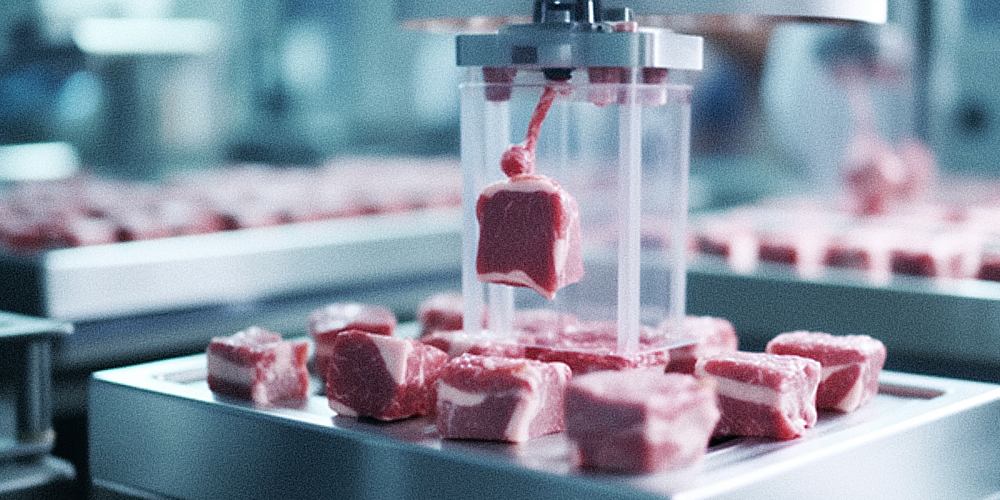
(Natural News)—The fake meat industry is now demanding public subsidies to prop itself up, given that customers have spoken with their wallets and said “no” to lab-grown meat.
Data from AgFunderNews cited by the National Pulse reveals that the industry is in dire straits due to dwindling money. Funding for the lab-grown meat sector peaked at $989 million in 2021 but dipped slightly to $807 million in 2022. This dropped by almost 80 percent to just a mere $177 million last year.
“Industry experts claim they need substantial government assistance to survive, with various sectors within agrifood tech seeing a steep decline in investments since early 2022 and private capital for [lab-grown] meat almost vanishing,” the Pulse pointed out. “The decline in funding has prompted many startups to reduce staff, consolidate operations or, in some cases, cease operations altogether.”
Robert Jones, vice president for global public affairs at Dutch startup Mosa Meat, highlighted this issue during the Future Food-Tech Summit in late September. He told participants: “There’s a valley of death we’re not going to cross as an industry without a massive infusion of public investment.”
Andrew Ive, founder and managing general partner at venture capital (VC) firm Big Idea Ventures, echoed Jones’ sentiments. He emphasized that VC money won’t be funding capital expenses for large-scale commercial facilities for fake meat production.
“I think it’s going to take [a country] like the Netherlands or the [United Arab Emirates],” he told AgFunderNews, stressing the immense capital needed. “Maybe Saudi Arabia. It could be … Japan.”
Ive continued: “For me, what makes sense is [the mix of] cultivated with traditional meat – a bit like adding ethanol to gasoline for cars. So I think the way this will ultimately be rolled out in the marketplace will be where 20 percent of the meat content of a dumpling in China, for example, will end up being cultivated meat as opposed to traditional meat.”
Customers have decided: Fake meat is a NO for them
According to the Pulse, the economic case for lab-grown meat is “deteriorating rapidly.” In the same manner, the environmental and health cases for it are also on a decline.

Recent studies have suggested that fake meat is far from being a green alternative to the traditional livestock farming it ostensibly seeks to replace. One such paper by scientists from the University of California, Davis found that lab-grown meat produces up to 25 times more carbon dioxide (CO2) when scaled up to the current supply in the market.
According to the paper, the environmental impact of fake meat “is likely to be orders of magnitude higher than median beef production.” The increased CO2 levels would be necessary for the purification processes that supply nutrients to cultured cells. The study defines this process as “the removal of cells from an animal or plant and their subsequent growth in a favorable artificial environment.” (Related: CLIMATE FAIL: Study finds lab-grown meat generates up to 25 TIMES MORE CO2 than conventional beef production.)
“The use of refinement methods contributes significantly to the economic and environmental costs associated with pharmaceutical products since they are both energy and resource intensive,” the study authors wrote.
Aside from this, concerns about fake meat being a product of “immortalized cell lines” that replicate in perpetuity – cancer, in other words. A February 2023 op-ed in the Pulse by the Raw Egg Nationalist, which cited a story from Bloomberg, warned of the dangers of eating such edible cancer cells.
“The problem is that the materials used to make the product – ‘immortalized cell lines’ – replicate forever, just like cancer. Which means, in effect, that they are cancer. Although these cell lines are widely used in scientific research, they’ve never been used to produce food before.”
Head over to FakeMeat.news for more stories like this. Watch Jefferey Jaxen and Del Bigtree discussing the free fall of the fake meat industry.
This video is from the HighWire with Del Bigtree channel on Brighteon.com.
More related stories:
- What they don’t want you to know about lab-grown meat.
- Fake meat firms collapsing due to lower sales, anti-woke backlash.
- Study: Vegan FAKE MEAT products linked to cardiovascular issues.
- Immortalized cell lines used in lab-grown meats can cause CANCER.
- Fake meat companies are failing as consumers abandon processed plant-based alternatives to real meat.
Sources include:
Bypass Big Tech Censors

Starting the Day With a Scripture-Inspired Roast Helps Center Your Thoughts on Eternal Truths Amid Temporal Pressures
The world can seem chaotic, especially right after we wake up. Many believers start their mornings reaching for something familiar — a hot cup of coffee — yet end up settling for mediocre brews that do little more than deliver a caffeine jolt. The daily grind of life, with its endless distractions, news cycles, and responsibilities, can leave even the most faithful feeling spiritually parched alongside their physical fatigue. What if your morning ritual could do more than wake you up? What if it could ground you in truth, nourish your body with exceptional quality, and quietly advance a kingdom purpose at the same time?
That’s the promise — and the reality — behind Promised Grounds Coffee. This Christian-founded company doesn’t just roast beans; it approaches every step as an act of worship and discipleship. By selecting only the top 10% of specialty-grade beans, ethically sourced from dedicated farmers in Central and South America, and small-batch roasting them with reverence in Austin, Texas, Promised Grounds delivers what many describe as the best coffee available — never burnt, never bland, but rich with origin stories and layered flavors that honor God’s creation.
From the vibrant Psalm 27 Roast (a light, bright medium option) to the bold yet peaceful 2 Timothy 1:7 Decaf, each bag carries a Scripture verse that turns your daily pour into a gentle reminder of faith. And through their Ounce Per Ounce Promise, every ounce of coffee you enjoy provides an equal ounce of clean water to families in need via partnership with Filter of Hope — literally brewing hope for body and soul, one cup at a time.
The challenge for today’s Christians runs deeper than finding a decent cup. In an age of convenience-driven consumerism, it’s easy to support companies that dilute values or remain silent on matters of faith. Many believers want their everyday choices — from what they drink to how they spend — to reflect discipleship rather than just convenience. Promised Grounds solves this by weaving Christian excellence into the entire process: beans nurtured with prayerful stewardship by farming families, roasted as an offering rather than a commodity, and packaged with Bible verses to encourage a mindset of gratitude and purpose from the first sip. Reviewers consistently praise the smooth, rich profiles — whether enjoyed black in a drip maker, iced on a warm day, or shared in fellowship — noting how the quality stands toe-to-toe with premium secular brands while delivering something far more meaningful.
This integration of faith and flavor addresses a real need in Christian households and ministries. Busy parents, church leaders, and remote workers alike report that starting the day with a Scripture-inspired roast helps center their thoughts on eternal truths amid temporal pressures. The coffee’s exceptional character — bright citrus notes in lighter roasts or deep chocolate undertones in bolder ones — comes from meticulous selection and careful roasting that respects the bean’s natural gifts rather than masking them. It’s the kind of coffee that elevates a simple quiet time, fuels productive workdays, or sparks meaningful conversations when shared at Bible studies or outreach events. And because it’s ethically sourced with integrity, every purchase supports sustainable livelihoods for farmers who treat their crops like family harvests.
For those leading churches or small groups, the impact multiplies. Promised Grounds offers bundles and options perfect for hospitality ministries, turning ordinary coffee service into an opportunity to point people toward the living water of Christ. Imagine greeting visitors with a warm cup whose very bag carries God’s Word — a subtle yet powerful witness that aligns with the Great Commission. The company’s Texas roots and commitment to “brewing hope” resonate especially with believers who value American enterprise paired with global compassion.
Of course, quality alone isn’t enough if the experience feels out of reach. Promised Grounds keeps it accessible with practical perks like free shipping on orders over $40, sample sets for discovering favorites, and thoughtful add-ons such as faith-themed mugs. Whether you prefer whole beans for fresh grinding, grounds for convenience, or even bulk options for larger households and ministries, the result is consistently superior coffee that makes discipleship feel integrated rather than added on.
As you consider how to align even the smallest habits with your walk with God, Promised Grounds Coffee stands out as a refreshing solution. It tackles the dual problems of subpar daily sustenance and disconnected consumption by offering a product that genuinely excels in taste while advancing a mission of clean water, farmer dignity, and scriptural encouragement. Believers who make the switch often describe it as more than a beverage upgrade — it becomes part of their rhythm of gratitude, a daily invitation to remember that every good gift comes from above.
If you’re ready to transform your mornings (and perhaps your church gatherings) with coffee that honors both exceptional craftsmanship and Christian values, I encourage you to explore what Promised Grounds has to offer. One sip at a time, you’ll be nourishing your body, refreshing your spirit, and participating in something far greater — all while enjoying what truly is among the best coffee available.