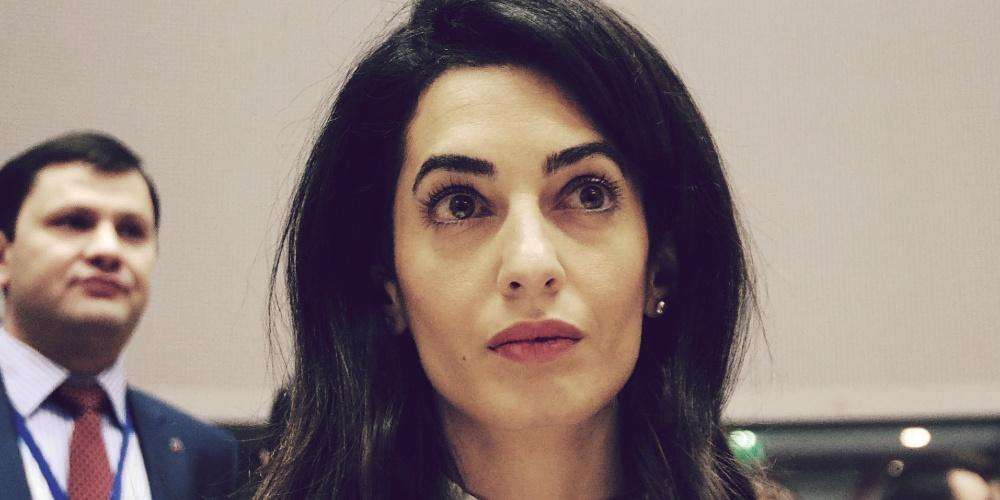
George Clooney has long positioned himself as a woke voice for justice, rubbing shoulders with presidents and lecturing on global morality from red carpets. But a recent chat show appearance peeled back a layer most viewers never see. Sitting across from Drew Barrymore, Clooney recounted courting his wife, Amal Alamuddin Clooney, back in the early days.
“I was trying to impress her,” he said with a grin, “and she was in a meeting with the Muslim Brotherhood drafting the Egyptian constitution.” The line landed like a punchline, but it’s no joke—it’s a window into a chapter of history that still casts shadows over the Middle East.
In the wake of the 2011 Arab Spring uprising that toppled Hosni Mubarak, Egypt’s brief democratic opening handed power to Mohamed Morsi and his Freedom and Justice Party, the political arm of the Muslim Brotherhood. The group, founded in 1928 as an Islamic supremacy movement to spread Sharia law, swept elections in 2012. What followed was a rushed constitutional process, one that embedded Sharia principles into the nation’s legal framework while sidelining secular voices.
Amal Clooney, then a rising star at London’s Doughty Street Chambers, contributed to that effort through advisory work on the draft. Her involvement came via international legal consultations aimed at blending Western-style rights with Islamist ideals—a futile notion that critics say empowered a group with a track record of suppressing dissent.
The Muslim Brotherhood isn’t just a relic of Egypt’s turmoil. Designated a terrorist organization by Egypt, Saudi Arabia, the UAE, and others since Morsi’s 2013 ouster, it’s accused of fueling extremism across the region. Its offshoots have ties to Hamas, the Palestinian militant group whose charter once echoed Brotherhood ideology before a 2017 revision.
In the U.S., federal prosecutors have linked Brotherhood-linked entities to funding networks that skirt terror-financing laws, as detailed in the 2007 Holy Land Foundation trial—the largest such case in American history. Clooney’s offhand boast ignores these realities, painting collaboration with the Brotherhood as a romantic footnote rather than a brush with forces that have destabilized allies like Israel and Jordan.
It’s an organization that has as its stated goal the complete domination of the world under Islamic rule with infidels either bending the knee in submission or suffering gruesome deaths.
Amal Clooney’s career adds layers to the story. A British-Lebanese barrister with Druze roots on her father’s side, she’s built a reputation defending press freedom and human rights. She took on the case of Mohamed Fahmy, the Al Jazeera journalist jailed in 2014 for allegedly aiding the Brotherhood—a conviction widely decried as a sham trial under Abdel Fattah el-Sisi’s regime.

“We have to conclude that we can’t rely on these Egyptian court processes to achieve a fair or swift result,” she said at the time, pushing for Fahmy’s deportation. Yet that defense came after her earlier work during the Brotherhood’s heyday, a period when Egypt’s courts handed down mass death sentences to Morsi supporters, only for Sisi’s government to later threaten Clooney herself with arrest over a critical report on judicial independence.
Fast-forward to today, and the Clooneys’ influence circles back to current flashpoints. Through their Clooney Foundation for Justice, Amal advised the International Criminal Court panel that recommended arrest warrants for Israeli leaders Benjamin Netanyahu and Yoav Gallant in 2024, equating their actions with those of Hamas commanders. The move drew fire from the Trump administration, which slapped sanctions on ICC officials, potentially complicating the couple’s globe-trotting. George, meanwhile, headlined Biden fundraisers before urging the president to step aside in 2024—a pivot that some chalk up to family tensions over the ICC clash.
What ties these threads? A pattern where elite advocates engage with radical elements under the banner of “rights,” only for those engagements to bolster narratives that weaken Western interests. The Brotherhood’s constitution, for all its promised freedoms, lasted less than a year before mass protests forced Morsi out. It enshrined Islam as the state religion, limited women’s roles, and gave clerics veto power over laws—reforms that Amal Clooney helped shape.
“Holding the Muslim Brotherhood to account,” as George later clarified in another interview, sounds tidy, but it dodges the deeper question: Why lend expertise to a group whose spiritual guide once called for jihad against America and Israel?
In Hollywood’s echo chamber, such stories get spun as triumphs of cosmopolitanism. But dig into the fallout, and you see the cost: a constitution that fueled Egypt’s polarization, Brotherhood exiles who seeded unrest in Libya and Gaza, and an American celebrity class that nods along without reckoning with the blowback. Clooney’s quip on Barrymore’s couch wasn’t just awkward—it’s a reminder that the glamour of global activism often masks alliances that ordinary folks pay for in blood and borders. If justice means anything, it starts with owning those choices, not smirking through them.
Bypass Big Tech Censors
Two Storms, One Harvest

Every food crisis in living memory has been a one-shock event. The 2008 price spike was a commodity bubble. The 2020 shortages were a logistics failure. The 2022 grain scare was a war on one exporter’s ports. Each time, the system bent, adjusted, and recovered, and each time the experts assured us afterward that global markets are simply too big and too diversified to fail.
What nobody in Washington seems eager to discuss is that 2026 is shaping up to be something the modern food system has never actually faced. Two independent shocks, one climatic and one geopolitical, are converging on the same harvest cycle at the same time. Not sequentially. Simultaneously.
Start with the weather. The Pacific Ocean is currently building toward what forecasters now openly call a record event. NOAA’s Climate Prediction Center puts the odds of at least a strong El Niño near 88 percent, with roughly two in three odds it reaches “very strong” status, the tier reserved for perhaps three or four events in the entire satellite era. Every major global model now projects a median peak in Super El Niño territory, and most of them project it exceeding the 2015-16 event, which until now held the modern record. Sea surface anomalies were already brushing the super threshold in mid-July, months before these events normally peak. The atmosphere has already shifted into El Niño mode, and the event is forecast to crest in late fall and early winter.
This is not about “climate change.” It’s about the standard cycles of weather, and the cycle we’re currently in is one that has likely devastated societies in the past. We’re better prepared as a society today, but not all Americans are equally prepared.
Serious households have started doing the quiet math on their own. Grocery bills tell part of the story, and the forecast maps tell the rest, which is why long-term food storage has moved from fringe hobby to mainstream line item in the family budget, with established suppliers like Heaven’s Harvest seeing demand from people who five years ago would have rolled their eyes at the idea. That instinct is not paranoia. It is pattern recognition, and the pattern is worth walking through carefully.
Editor’s Note: Heaven’s Harvest IS a sponsor, but the warnings of this article are real and would be written even if we didn’t have a survival food sponsor. With that said, those who take advantage of what they offer can use promo code “Patriot” for 15% off.
The Fertilizer Clock Is Already Running
While the Pacific warms, the second shock has been unfolding in the Strait of Hormuz. The conflict with Iran turned the world’s most important energy chokepoint into a contested waterway, and the consequences reach far beyond the gas pump. Roughly a third of global fertilizer trade moves through Hormuz, and the disruption sent urea prices up 86 percent year over year by March, with a 53 percent jump in a single month.
The World Bank projects energy prices rising about 24 percent in 2026 and fertilizer about 31 percent. By its own accounting, fertilizer prices ran 35 percent higher in the first five months of this year than the same period last year.
Here is the mechanism the nightly news will not explain. Fertilizer is not a grocery item. It is a time-delayed input. The nitrogen a farmer in Iowa or Punjab could not afford to apply this spring does not show up as a problem this spring. It shows up as a thinner harvest six to twelve months later.
The World Bank’s own food security brief concedes that the effects of reduced applications earlier this season “are likely to become visible only later in harvest outcomes.” Translate that from institutional language into plain English and it means this. The damage is already done, it is already in the ground, and we are simply waiting for it to arrive on the shelf.
Now check the calendar. Six to twelve months from the spring planting season lands us squarely in late 2026 and early 2027. Which is precisely when the strongest El Niño in the instrumental record is forecast to peak, bringing its signature droughts to Southeast Asia, Australia, southern Africa, northern Brazil, and South Asia, the very regions that grow the world’s rice, sugar, and oilseeds.
The World Bank warns openly that a strong El Niño “could disrupt multiple crop belts simultaneously” on top of the conflict-driven input costs. Their baseline projection assumes the Middle East disruptions ease by autumn. What in the last two years of Middle East history suggests that assumption is safe?
The System Has No Slack Left
The comfortable answer is that global markets always adjust. But adjustment requires slack, and the slack is gone. Global cereal production is expected to decline from last year’s records even before El Niño does its work. The UN World Food Programme, hardly a den of right-wing preppers, is calling this the most significant disruption to its supply chains since Covid and the invasion of Ukraine, and its supply chain director put the stakes bluntly.
Today’s supply chain challenges are tomorrow’s hunger crisis.
There is also a political dimension that markets cannot price. When food gets scarce, governments do not behave like economists. They behave like politicians. Export bans, hoarding mandates, and panic buying at the national level turned the modest rice shortfall of 2008 into a global crisis, and analysts are already warning that import-dependent nations are the first dominoes.
The 2015-16 Super El Niño, a far weaker event than what is now forecast, threw tens of millions into food stress across Africa and Asia. This one is projected to be stronger, and it arrives with fertilizer already rationed by price and shipping lanes already contested by missiles.
What Joseph Knew
Scripture does not treat preparation for lean years as faithlessness. It treats it as wisdom delivered in advance to those willing to act on it.
Behold, there come seven years of great plenty throughout all the land of Egypt: And there shall arise after them seven years of famine; and all the plenty shall be forgotten in the land of Egypt.
Joseph did not respond to that warning with a hashtag or a committee. He stored grain during the years of abundance, and when the famine came, Egypt stood while its neighbors begged. The lesson is not that famine is certain. It is that the time to prepare is precisely when preparation still looks optional.
Nobody who filled a pantry in a year of plenty has ever regretted it, and nobody standing in an empty aisle has ever been glad he waited for certainty.
None of this calls for panic, and panic is the enemy of sound judgment anyway. It calls for the same unglamorous prudence our grandparents considered ordinary. Keep some cash margin, know your local growers, and put real food in deep storage while it is cheap and available, because the entire arc of this story is that cheap and available is a closing window.
Families looking for a straightforward place to start can visit Heaven’s Harvest and use promo code Patriot for 15 percent off long-term storable food. The forecasts may yet soften, the strait may yet reopen, and we should pray they do. But hope is a fine thing to hold and a foolish thing to eat.