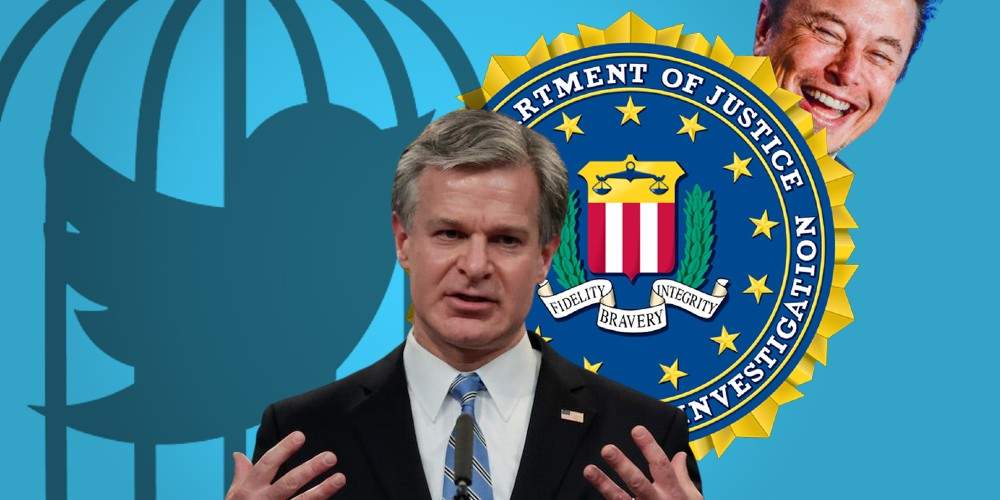
If anyone thought the Twitter Files drops that have been happening for over a week now would lead with the bombshells and then trickle out nothingburgers, think again. Today’s drop may very well be the biggest of them all because it exposes just how involved our government has been in censoring Americans. Prima facie, this is a direct attack against the 1st Amendment rights of American citizens.
How closely aligned were Twitter and the FBI? They were practically family, as Matt Taibbi’s latest drop reveals.
I will post the text from each of his Tweets here, edited only for formatting. The actual Tweets are below, including referenced images, followed by my commentary.
THREAD: The Twitter Files, Part Six TWITTER, THE FBI SUBSIDIARY
The #TwitterFiles are revealing more every day about how the government collects, analyzes, and flags your social media content. Twitter’s contact with the FBI was constant and pervasive, as if it were a subsidiary.
Between January 2020 and November 2022, there were over 150 emails between the FBI and former Twitter Trust and Safety chief Yoel Roth. Some are mundane, like San Francisco agent Elvis Chan wishing Roth a Happy New Year along with a reminder to attend “our quarterly call next week.” Others are requests for information into Twitter users related to active investigations. But a surprisingly high number are requests by the FBI for Twitter to take action on election misinformation, even involving joke tweets from low-follower accounts.
The FBI’s social media-focused task force, known as FTIF, created in the wake of the 2016 election, swelled to 80 agents and corresponded with Twitter to identify alleged foreign influence and election tampering of all kinds. Federal intelligence and law enforcement reach into Twitter included the Department of Homeland Security, which partnered with security contractors and think tanks to pressure Twitter to moderate content.
It’s no secret the government analyzes bulk data for all sorts of purposes, everything from tracking terror suspects to making economic forecasts. The #TwitterFiles show something new: agencies like the FBI and DHS regularly sending social media content to Twitter through multiple entry points, pre-flagged for moderation.
What stands out is the sheer quantity of reports from the government. Some are aggregated from public hotlines.

An unanswered question: do agencies like FBI and DHS do in-house flagging work themselves, or farm it out? “You have to prove to me that inside the fucking government you can do any kind of massive data or AI search,” says one former intelligence officer.
“HELLO TWITTER CONTACTS”: The master-canine quality of the FBI’s relationship to Twitter comes through in this November 2022 email, in which “FBI San Francisco is notifying you” it wants action on four accounts.
Twitter personnel in that case went on to look for reasons to suspend all four accounts, including @fromma , whose tweets are almost all jokes (see sample below), including his “civic misinformation” of Nov. 8.
Just to show the FBI can be hyper-intrusive in both directions, they also asked Twitter to review a blue-leaning account for a different joke, except here it was even more obvious that @clairefosterPHD, who kids a lot, was kidding.
“Anyone who cannot discern obvious satire from reality has no place making decisions for others or working for the feds,” said @ClaireFosterPHD, when told about the flagging. Of the six accounts mentioned in the previous two emails, all but two – @ClaireFosterPHD and @FromMa – were suspended.
In an internal email from November 5, 2022, the FBI’s National Election Command Post, which compiles and sends on complaints, sent the SF field office a long list of accounts that “may warrant additional action”. Agent Chan passed the list on to his “Twitter folks”. Twitter then replied with its list of actions taken. Note mercy shown to actor Billy Baldwin. Many of the above accounts were satirical in nature, nearly all (with the exceptions of Baldwin and @RSBNetwork) were relatively low engagement, and some were suspended, most with a generic, “Thanks, Twitter” letter.
When told of the FBI flagging, @Lexitollah replied: “My thoughts initially include 1. Seems like prima facie 1A violation 2. Holy cow, me, an account with the reach of an amoeba 3. What else are they looking at?”
“I can’t believe the FBI is policing jokes on Twitter. That’s crazy,” said @Tiberius444.
In a letter to former Deputy General Counsel (and former top FBI lawyer) Jim Baker on Sep. 16, 2022, legal exec Stacia Cardille outlines results from her “soon to be weekly” meeting with DHS, DOJ, FBI, and the Office of the Director of National Intelligence.
The Twitter exec writes she explicitly asked if there were “impediments” to the sharing of classified information “with industry.” The answer? “FBI was adamant no impediments to sharing exist.”
This passage underscores the unique one-big-happy-family vibe between Twitter and the FBI. With what other firm would the FBI blithely agree to “no impediments” to classified information? At the bottom of that letter, she lists a series of “escalations” apparently raised at the meeting, which were already “handled.”
About one, she writes: “Flagged a specific Tweet on Illinois use of modems to transmit election results in possible violation of the civic integrity policy (except they do use that tech in limited circumstances).”

Another internal letter from January, 2021 shows Twitter execs processing an FBI list of “possible violative content” tweets. Here, too, most tweets contained the same, “Get out there and vote Wednesday!” trope and had low engagement. This is what the FBI spends its time on.
In this March, 2021 email, an FBI liaison thanks a senior Twitter exec for the chance to speak to “you and the team,” then delivers a packet of “products”.
The executive circulates the “products,” which are really DHS bulletins stressing the need for greater collaboration between law enforcement and “private sector partners.”
The ubiquity of the 2016 Russian interference story as stated pretext for building out the censorship machine can’t be overstated. It’s analogous to how 9/11 inspired the expansion of the security state.
While the DHS in its “products” pans “permissive” social media for offering “operational advantages” to Russians, it also explains that the “Domestic Violent Extremist Threat” requires addressing “information gaps”.
FBI in one case sent over so many “possible violative content” reports, Twitter personnel congratulated each other in Slack for the “monumental undertaking” of reviewing them.

There were multiple points of entry into Twitter for government-flagged reports. This letter from Agent Chan to Roth references Teleporter, a platform through which Twitter could receive reports from the FBI.
Reports also came from different agencies. Here, an employee recommends “bouncing” content based on evidence from “DHS etc”. State governments also flagged content.
“WHY WAS NO ACTION TAKEN?” Below, Twitter execs – receiving an alert from California officials, by way of “our partner support portal” – debate whether to act on a Trump tweet.
Here, a video was reported by the Election Integrity Project (EIP) at Stanford, apparently on the strength of information from the Center for Internet Security (CIS).
If that’s confusing, it’s because the CIS is a DHS contractor, describes itself as “partners” with the Cyber and Internet Security Agency (CISA) at the DHS.
The EIP is one of a series of government-affiliated think tanks that mass-review content, a list that also includes the Atlantic Council’s Digital Forensics Research Laboratory, and the University of Washington’s Center for Informed Policy.

The takeaway: what most people think of as the “deep state” is really a tangled collaboration of state agencies, private contractors, and (sometimes state-funded) NGOs. The lines become so blurred as to be meaningless.
Twitter Files researchers are moving into a variety of new areas now. Watch @BariWeiss, @ShellenbergerMD, and this space for more, soon.
Here are the actual Tweets:
1. THREAD: The Twitter Files, Part Six
TWITTER, THE FBI SUBSIDIARY— Matt Taibbi (@mtaibbi) December 16, 2022
3. Twitter’s contact with the FBI was constant and pervasive, as if it were a subsidiary.
— Matt Taibbi (@mtaibbi) December 16, 2022
5. Some are mundane, like San Francisco agent Elvis Chan wishing Roth a Happy New Year along with a reminder to attend “our quarterly call next week.” Others are requests for information into Twitter users related to active investigations.
— Matt Taibbi (@mtaibbi) December 16, 2022
7. The FBI’s social media-focused task force, known as FTIF, created in the wake of the 2016 election, swelled to 80 agents and corresponded with Twitter to identify alleged foreign influence and election tampering of all kinds.
— Matt Taibbi (@mtaibbi) December 16, 2022
9. It’s no secret the government analyzes bulk data for all sorts of purposes, everything from tracking terror suspects to making economic forecasts.
— Matt Taibbi (@mtaibbi) December 16, 2022
11. What stands out is the sheer quantity of reports from the government. Some are aggregated from public hotlines: pic.twitter.com/cm9JjEXUSm
— Matt Taibbi (@mtaibbi) December 16, 2022
“HELLO TWITTER CONTACTS”: The master-canine quality of the FBI’s relationship to Twitter comes through in this November 2022 email, in which “FBI San Francisco is notifying you” it wants action on four accounts: pic.twitter.com/LjgB6fxENo
— Matt Taibbi (@mtaibbi) December 16, 2022
15. Just to show the FBI can be hyper-intrusive in both directions, they also asked Twitter to review a blue-leaning account for a different joke, except here it was even more obvious that @clairefosterPHD, who kids a lot, was kidding: pic.twitter.com/uLxHayY11C
— Matt Taibbi (@mtaibbi) December 16, 2022
17.Of the six accounts mentioned in the previous two emails, all but two – @ClaireFosterPHD and @FromMa – were suspended.
— Matt Taibbi (@mtaibbi) December 16, 2022
19.Agent Chan passed the list on to his "Twitter folks": pic.twitter.com/eXaZnC3I7y
— Matt Taibbi (@mtaibbi) December 16, 2022
21.Many of the above accounts were satirical in nature, nearly all (with the exceptions of Baldwin and @RSBNetwork) were relatively low engagement, and some were suspended, most with a generic, “Thanks, Twitter” letter: pic.twitter.com/0S0XoqhwYD
— Matt Taibbi (@mtaibbi) December 16, 2022
23.“I can't believe the FBI is policing jokes on Twitter. That's crazy,” said @Tiberius444.
— Matt Taibbi (@mtaibbi) December 16, 2022
25.The Twitter exec writes she explicitly asked if there were “impediments” to the sharing of classified information “with industry.” The answer? “FBI was adamant no impediments to sharing exist.”
— Matt Taibbi (@mtaibbi) December 16, 2022
https://t.co/dtvy82pfce the bottom of that letter, she lists a series of “escalations” apparently raised at the meeting, which were already “handled.”
— Matt Taibbi (@mtaibbi) December 16, 2022
29.Another internal letter from January, 2021 shows Twitter execs processing an FBI list of “possible violative content” tweets: pic.twitter.com/Dwad3lGM4j
— Matt Taibbi (@mtaibbi) December 16, 2022
31. In this March, 2021 email, an FBI liaison thanks a senior Twitter exec for the chance to speak to “you and the team,” then delivers a packet of “products”: pic.twitter.com/POOpYrd9q8
— Matt Taibbi (@mtaibbi) December 16, 2022
33.The ubiquity of the 2016 Russian interference story as stated pretext for building out the censorship machine can’t be overstated. It’s analogous to how 9/11 inspired the expansion of the security state. pic.twitter.com/GSaEzM0aYo
— Matt Taibbi (@mtaibbi) December 16, 2022
35.FBI in one case sent over so many “possible violative content” reports, Twitter personnel congratulated each other in Slack for the “monumental undertaking” of reviewing them: pic.twitter.com/rt5WzhfCga
— Matt Taibbi (@mtaibbi) December 16, 2022
37.Reports also came from different agencies. Here, an employee recommends “bouncing” content based on evidence from “DHS etc”: pic.twitter.com/5DP8DEFZiO
— Matt Taibbi (@mtaibbi) December 16, 2022
39.Twitter for instance received reports via the Partner Support Portal, an outlet created by the Center for Internet Security, a partner organization to the DHS.
— Matt Taibbi (@mtaibbi) December 16, 2022
https://t.co/4zD4nEkDdW, a video was reported by the Election Integrity Project (EIP) at Stanford, apparently on the strength of information from the Center for Internet Security (CIS): pic.twitter.com/kJfJ6gDrb1
— Matt Taibbi (@mtaibbi) December 16, 2022
43.The EIP is one of a series of government-affiliated think tanks that mass-review content, a list that also includes the Atlantic Council’s Digital Forensics Research Laboratory, and the University of Washington’s Center for Informed Policy.
— Matt Taibbi (@mtaibbi) December 16, 2022
45. Twitter Files researchers are moving into a variety of new areas now. Watch @BariWeiss, @ShellenbergerMD, and this space for more, soon.
— Matt Taibbi (@mtaibbi) December 16, 2022
What does all this mean? While many if not most of us were aware that direct government influence, including from the Deep State, has huge impacts on our freedoms on social media platforms, it would seem the conspiracy theorists who claimed the Deep State essentially had carte blanche were correct. Twitter employees were giddy to be doing the bidding of government to stifle American citizens.
As a non-government entity, Twitter has always enjoyed a certain level of control over what they allow on their platform. Many of us have argued that their Section 230 protections mean they cannot suppress legal speech, but thus far that avenue of attack against censorship has yielded limited fruit.
These Twitter Files may be a gamechanger in the fight. Government may not participate in quashing free speech and the revelations here demonstrate they are breeching our constitutional rights. But it’s actually worse than that, if one can imagine. They have used their control over Big Tech companies to influence the results of elections and to steer sentiment to the left in many regards. Taibbi attempts to highlight that attacks by the Deep State against free speech included attacks on leftists, but it’s crystal clear the lion’s share of censorship was distributed against conservatives.
Corporate media won’t cover this. Democrats will ignore it. Unfortunately, most Republican lawmakers won’t lift a finger either. Hopefully, someone in government with courage and a conscience will start holding the corrupt FBI accountable.
Bypass Big Tech Censors
Starting the Day With a Scripture-Inspired Roast Helps Center Your Thoughts on Eternal Truths Amid Temporal Pressures
The world can seem chaotic, especially right after we wake up. Many believers start their mornings reaching for something familiar — a hot cup of coffee — yet end up settling for mediocre brews that do little more than deliver a caffeine jolt. The daily grind of life, with its endless distractions, news cycles, and responsibilities, can leave even the most faithful feeling spiritually parched alongside their physical fatigue. What if your morning ritual could do more than wake you up? What if it could ground you in truth, nourish your body with exceptional quality, and quietly advance a kingdom purpose at the same time?
That’s the promise — and the reality — behind Promised Grounds Coffee. This Christian-founded company doesn’t just roast beans; it approaches every step as an act of worship and discipleship. By selecting only the top 10% of specialty-grade beans, ethically sourced from dedicated farmers in Central and South America, and small-batch roasting them with reverence in Austin, Texas, Promised Grounds delivers what many describe as the best coffee available — never burnt, never bland, but rich with origin stories and layered flavors that honor God’s creation.
From the vibrant Psalm 27 Roast (a light, bright medium option) to the bold yet peaceful 2 Timothy 1:7 Decaf, each bag carries a Scripture verse that turns your daily pour into a gentle reminder of faith. And through their Ounce Per Ounce Promise, every ounce of coffee you enjoy provides an equal ounce of clean water to families in need via partnership with Filter of Hope — literally brewing hope for body and soul, one cup at a time.
The challenge for today’s Christians runs deeper than finding a decent cup. In an age of convenience-driven consumerism, it’s easy to support companies that dilute values or remain silent on matters of faith. Many believers want their everyday choices — from what they drink to how they spend — to reflect discipleship rather than just convenience. Promised Grounds solves this by weaving Christian excellence into the entire process: beans nurtured with prayerful stewardship by farming families, roasted as an offering rather than a commodity, and packaged with Bible verses to encourage a mindset of gratitude and purpose from the first sip. Reviewers consistently praise the smooth, rich profiles — whether enjoyed black in a drip maker, iced on a warm day, or shared in fellowship — noting how the quality stands toe-to-toe with premium secular brands while delivering something far more meaningful.
This integration of faith and flavor addresses a real need in Christian households and ministries. Busy parents, church leaders, and remote workers alike report that starting the day with a Scripture-inspired roast helps center their thoughts on eternal truths amid temporal pressures. The coffee’s exceptional character — bright citrus notes in lighter roasts or deep chocolate undertones in bolder ones — comes from meticulous selection and careful roasting that respects the bean’s natural gifts rather than masking them. It’s the kind of coffee that elevates a simple quiet time, fuels productive workdays, or sparks meaningful conversations when shared at Bible studies or outreach events. And because it’s ethically sourced with integrity, every purchase supports sustainable livelihoods for farmers who treat their crops like family harvests.
For those leading churches or small groups, the impact multiplies. Promised Grounds offers bundles and options perfect for hospitality ministries, turning ordinary coffee service into an opportunity to point people toward the living water of Christ. Imagine greeting visitors with a warm cup whose very bag carries God’s Word — a subtle yet powerful witness that aligns with the Great Commission. The company’s Texas roots and commitment to “brewing hope” resonate especially with believers who value American enterprise paired with global compassion.
Of course, quality alone isn’t enough if the experience feels out of reach. Promised Grounds keeps it accessible with practical perks like free shipping on orders over $40, sample sets for discovering favorites, and thoughtful add-ons such as faith-themed mugs. Whether you prefer whole beans for fresh grinding, grounds for convenience, or even bulk options for larger households and ministries, the result is consistently superior coffee that makes discipleship feel integrated rather than added on.
As you consider how to align even the smallest habits with your walk with God, Promised Grounds Coffee stands out as a refreshing solution. It tackles the dual problems of subpar daily sustenance and disconnected consumption by offering a product that genuinely excels in taste while advancing a mission of clean water, farmer dignity, and scriptural encouragement. Believers who make the switch often describe it as more than a beverage upgrade — it becomes part of their rhythm of gratitude, a daily invitation to remember that every good gift comes from above.
If you’re ready to transform your mornings (and perhaps your church gatherings) with coffee that honors both exceptional craftsmanship and Christian values, I encourage you to explore what Promised Grounds has to offer. One sip at a time, you’ll be nourishing your body, refreshing your spirit, and participating in something far greater — all while enjoying what truly is among the best coffee available.