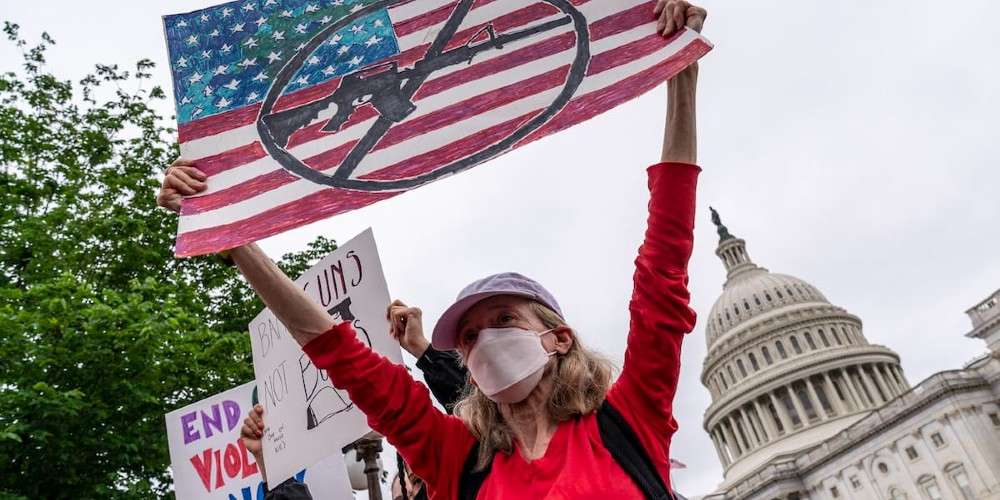
Whenever there’s a mass shooting, Democrats only need to hear one piece of information before beginning their politicization of the tragedy. If the shooter was white, the nation has a massive white supremacy problem that will kill us all if we don’t address it. If the shooter isn’t white, then the nation has a massive gun problem that will kill us all if we don’t address it.
That’s it. That’s their game plan. And it plays out like clockwork every single time there’s a mass shooting.
Do we have a white supremacy problem? Yes, white supremacy is bad, but is it as massive of a problem as we’re being told? James Varney from Real Clear Investigations wrote an article about the current propaganda from the Anti-Defamation League, which I’ve posted below with permission. The biggest takeaway from the article is this: Even if we ignore the questionable method they used to come up with 244 white supremacist murders in the last decade, it’s still tiny compared to the 164,000 murders we’ve had in the United States in the same time period.
Do we have a gun problem? I addressed this in the latest episode of The JD Rucker Political Report on America Out Loud Talk Radio. The short answer is, “No.” Unless we want the whole country to be like massively gun-controlled Chicago, we should not be adding more laws to the books. Let’s enforce the ones we have and focus on the mental health of the nation instead of trying to take our guns.
Here’s the article by Varney:
The Anti-Defamation League Murder Report That Cried ‘White Supremacist’
In May 2021, two members of the Family Values, a white supremacist prison gang allegedly killed a member of the rival Southwest Honkeys prison gang over a longstanding beef. Three months later a New Jersey man who had vandalized synagogues and distributed neo-Nazi pamphlets strangled his wife.
On the surface, the crimes would appear to have little more in common than their brutality. But the Anti-Defamation League includes these murders by white men of other whites in its tally of right-wing and white supremacist murders in its report, “Murder & Extremism in the United States in 2021.”
“In 2021, white supremacists were responsible for more murders than any other type of extremist; in many years, they comprised an outright majority of the extremist murders that year,” the report said. “Indeed, over the past 10 years, white supremacists have committed 244 (55%) of the 443 killings that the ADL (COE) has documented.”

The ADL also claims that other “right-wing extremists” – including those it describes as “anti-government” and “incel/manosphere” (typically, involuntary celibates or misogynists) – were responsible for another 20% of extremist killings during the 10-year-period (2012-21).
The report has been cited repeatedly in media pieces as evidence of the lethal threat posed by far-right extremists since a mentally disturbed 18-year-old white supremacist murdered 10 African Americans and injured three others at a Buffalo market on May 14. Its stark warning has helped provide a backdrop for the narrative advanced by the White House, advocacy groups, and national media outlets that toxic white nationalism permeates American society. “White supremacy is a poison. It’s a poison … running through our body politic,” President Biden said in his speech in Buffalo following the shooting. “… And it’s been allowed to grow and fester right before our eyes.”
But a closer examination of the statistics compiled by the ADL – which did not respond to multiple requests for comment – casts doubt on their use as evidence that African Americans or any other Americans are under increasing or serious threats from racist white zealots. They were publicized in a month of back-to-back mass killings by mentally disturbed young men, the latest in Uvalde, Texas, that suggest massacres defy such pat analysis.
Critics note that the ADL, like other organizations tracking extremism, rarely offers context to claims regarding extremist murders by comparing them to broader homicide statistics. During the same 10-year period cited by the ADL in its 2021 report citing 244 murders by white supremacists, there were at least 165,000 murders in the U.S., meaning those the group attributes to white supremacists accounted for .001% of such violent deaths in that decade.
That statistic pales in comparison with those of major cities that have seen shocking increases in bloodshed, with recent annual murder totals breaking or nearing records set in the 20th century. Chicago had 797 murders in 2021, the highest total in 25 years, while much smaller Minneapolis, one year after George Floyd died in police custody there, had 96 murders, one shy of the city’s 1995 record. Huge jumps in murders also occurred in Philadelphia, Los Angeles, and other metropolitan areas.
“The FBI has not issued the official number of murders in the U.S. in 2021, but it is expected to exceed the number of murders in 2020: 21,570 — of which, according to ADL, 23 were committed by extremists,” Carl Moody, an economist at the College of William & Mary who studies crime, told RealClearInvestigations.
“The data presented by the ADL could also be characterized as follows: the number of murders committed by extremists is very small, only 29 in 2021, of which less than half were committed by white supremacists,” Moody said. “It is also 63% lower than the maximum number (78) in 2016, so extremism is down since 2016. In 2020, according to the CDC, 1080 people were killed falling out of bed. Therefore, you are 47 times more likely to be killed by a bed than by an extremist.”
“It’s important that we get the numbers right and in perspective,” said John Lott, president of the Crime Prevention Research Center. “And we’ve had mainstream narratives that make it sound like they are all like the Buffalo killer. But there are very specific circumstances to a number of these shootings. If there is a significant threat to blacks from these kinds of mass attacks they need to know that. Otherwise, you’re creating divisions that don’t need to be there.”
Crime experts also note that many of the killings cited by the ADL – such as the slaying committed by Shawn Lichtfuss, the New Jersey man who killed his wife, or John Hilt and Justin Murphy, the allegedly lethal members of the Family Values prison gang – were not hate crimes aimed at terrorizing blacks or other minorities.
These include:
- A white supremacist with a “swastika and SS tattoos on his face” who killed another man in an extended-stay hotel “following an argument over a social media post.”
- An alleged member of a Fresno, California, white supremacist street gang who “allegedly [shot] a man with whom he had long been feuding.”
- Four members of the New Mexico Aryan Brotherhood who “were involved in a shootout amongst themselves inside a vehicle.”
At the same time, critics say the ADL overstates the percentage of white supremacist murders because it omits some high-profile crimes committed by non-whites. Lott provided eight examples of mass killings – traditionally defined as those with four or more fatalities – excluded by the ADL in its decade-long tally. One of those was the 2016 attack a black man launched against white police officers in Dallas that killed 5 and wounded 11.
The ADL report also does not include the more recent carnage in Waukesha, Wisconsin, last November when a black man with a history of racist social posts drove into a mostly white crowd in a Christmas parade, killing six and injuring 62. For 2021, the ADL lists just two murders by people it classifies as “black nationalists.” If the Waukesha victims were included, black racist murders would account for 23% of extremist murders (8 of 35) for 2021.

“The Wisconsin car attack is one that is very hard to miss,” Lott said. “It is such an obvious and well-known case that you have to wonder if they omitted it because it goes against ‘their narrative.’”
The ADL’s own report indicates that many of the killings it attributes to white supremacists do not fit common understandings of racist hate crimes. Prison gang tattoo It reports, for example, that 76 of the 244 killings, or 31%, were committed by members, suspected members, or associates of white supremacist prison gangs. They were the deadliest group profiled, and “given the nature of prison gangs as organized crime groups, it is predictable that many of the murders would be related to traditional criminal activities, ranging from drug-related murders to killings committed in robberies.”
Indeed, the ADL admits that the majority of murders it attributes to white supremacists were non-ideological.
“Over the past 10 years, only 86 of the 244 white supremacist killings (35%) were ideological murders,” the report said. “The remainder were group-related but not ideological attacks, were related to traditional criminal activities, or were murders for which no clear motive could be determined.”
That finding tracks with a March 2021 report from Lott’s organization addressing what it called “the false narrative of white supremacists doing mass public shootings.” Examining all shootings involving four or more fatalities from 1998 to March 2021, it found in 71% of them “no mention of political affiliation” of the shooters. The report determined that “4% are right-wingers or conservatives or Republicans, 6% were liberals or Democrats or left-wing, and 10% were Muslim. About 9% are white supremacist, neo-Nazis, or anti-immigrant, but these people come from both the left and the right. Mass public shootings make up a small percentage of murders, and anti-minority mass public shooters are not the biggest threat even in that group.”
Brian Levin, who heads the Center for the Study of Hate & Extremism at California State University-San Bernardino, said it can be difficult to pinpoint precise motivations of mass murderers, as “we are seeing less rigid ideological killers who increasingly seem to browse at a buffet of hatreds.”

The Buffalo killer’s overwhelming hatred, however, was racist, as he expressed both the belief that blacks are inferior and angst over a kind of global conspiracy called “the great replacement theory,” Levin said.
In his 180-page rant published while he was allegedly opening fire in Buffalo, the extremist described himself at various points as a “mild/moderate left authoritarian,” and he viewed conservatism with contempt as a corporate catspaw.
“In whole or in part, he’s a Nazi,” Levin said. “He hates Jews, he hates blacks – hatred is the primary driver.”
To be sure, targeted racist mass murders invoke a terror that everyday murders do not – massacres such as those by Dylann Roof at an African-American church in Charleston in 2015 (9 dead, one injured); the Pittsburgh Tree of Life synagogue shooting in 2018 (11 dead, 6 injured); the 2019 attack at the El Paso Walmart (23 dead, 23 wounded); as well as the recent attack in Buffalo. When such killers target African Americans, Jews, or others on racist terms, the crimes have a disproportionate impact on how they and all Americans may perceive the atmosphere, Levin said.
“Not all crimes have the same effect on the American psyche,” Levin said. “I’ll leave it to others to talk about how the media covers it, but when Tony Soprano knocks off another criminal family wiseguy it does not have the kind of impact these manifesto mass killers do.”
Levin said his research supports the idea that right-wing extremists are a huge threat and he pointed to other studies that have drawn the same conclusion.

Nevertheless, critics say the evidence indicates that the emphasis the White House and media outlets have thrown on the threat posed by white supremacist killings is misleading.
“Death by extremist is an incredibly rare event,” said Moody, the William & Mary economist. “It is absurd to try to generalize from such tiny numbers.”
Bypass Big Tech Censors
Two Storms, One Harvest

Every food crisis in living memory has been a one-shock event. The 2008 price spike was a commodity bubble. The 2020 shortages were a logistics failure. The 2022 grain scare was a war on one exporter’s ports. Each time, the system bent, adjusted, and recovered, and each time the experts assured us afterward that global markets are simply too big and too diversified to fail.
What nobody in Washington seems eager to discuss is that 2026 is shaping up to be something the modern food system has never actually faced. Two independent shocks, one climatic and one geopolitical, are converging on the same harvest cycle at the same time. Not sequentially. Simultaneously.
Start with the weather. The Pacific Ocean is currently building toward what forecasters now openly call a record event. NOAA’s Climate Prediction Center puts the odds of at least a strong El Niño near 88 percent, with roughly two in three odds it reaches “very strong” status, the tier reserved for perhaps three or four events in the entire satellite era. Every major global model now projects a median peak in Super El Niño territory, and most of them project it exceeding the 2015-16 event, which until now held the modern record. Sea surface anomalies were already brushing the super threshold in mid-July, months before these events normally peak. The atmosphere has already shifted into El Niño mode, and the event is forecast to crest in late fall and early winter.
This is not about “climate change.” It’s about the standard cycles of weather, and the cycle we’re currently in is one that has likely devastated societies in the past. We’re better prepared as a society today, but not all Americans are equally prepared.
Serious households have started doing the quiet math on their own. Grocery bills tell part of the story, and the forecast maps tell the rest, which is why long-term food storage has moved from fringe hobby to mainstream line item in the family budget, with established suppliers like Heaven’s Harvest seeing demand from people who five years ago would have rolled their eyes at the idea. That instinct is not paranoia. It is pattern recognition, and the pattern is worth walking through carefully.
Editor’s Note: Heaven’s Harvest IS a sponsor, but the warnings of this article are real and would be written even if we didn’t have a survival food sponsor. With that said, those who take advantage of what they offer can use promo code “Patriot” for 15% off.
The Fertilizer Clock Is Already Running
While the Pacific warms, the second shock has been unfolding in the Strait of Hormuz. The conflict with Iran turned the world’s most important energy chokepoint into a contested waterway, and the consequences reach far beyond the gas pump. Roughly a third of global fertilizer trade moves through Hormuz, and the disruption sent urea prices up 86 percent year over year by March, with a 53 percent jump in a single month.
The World Bank projects energy prices rising about 24 percent in 2026 and fertilizer about 31 percent. By its own accounting, fertilizer prices ran 35 percent higher in the first five months of this year than the same period last year.
Here is the mechanism the nightly news will not explain. Fertilizer is not a grocery item. It is a time-delayed input. The nitrogen a farmer in Iowa or Punjab could not afford to apply this spring does not show up as a problem this spring. It shows up as a thinner harvest six to twelve months later.
The World Bank’s own food security brief concedes that the effects of reduced applications earlier this season “are likely to become visible only later in harvest outcomes.” Translate that from institutional language into plain English and it means this. The damage is already done, it is already in the ground, and we are simply waiting for it to arrive on the shelf.
Now check the calendar. Six to twelve months from the spring planting season lands us squarely in late 2026 and early 2027. Which is precisely when the strongest El Niño in the instrumental record is forecast to peak, bringing its signature droughts to Southeast Asia, Australia, southern Africa, northern Brazil, and South Asia, the very regions that grow the world’s rice, sugar, and oilseeds.
The World Bank warns openly that a strong El Niño “could disrupt multiple crop belts simultaneously” on top of the conflict-driven input costs. Their baseline projection assumes the Middle East disruptions ease by autumn. What in the last two years of Middle East history suggests that assumption is safe?
The System Has No Slack Left
The comfortable answer is that global markets always adjust. But adjustment requires slack, and the slack is gone. Global cereal production is expected to decline from last year’s records even before El Niño does its work. The UN World Food Programme, hardly a den of right-wing preppers, is calling this the most significant disruption to its supply chains since Covid and the invasion of Ukraine, and its supply chain director put the stakes bluntly.
Today’s supply chain challenges are tomorrow’s hunger crisis.
There is also a political dimension that markets cannot price. When food gets scarce, governments do not behave like economists. They behave like politicians. Export bans, hoarding mandates, and panic buying at the national level turned the modest rice shortfall of 2008 into a global crisis, and analysts are already warning that import-dependent nations are the first dominoes.
The 2015-16 Super El Niño, a far weaker event than what is now forecast, threw tens of millions into food stress across Africa and Asia. This one is projected to be stronger, and it arrives with fertilizer already rationed by price and shipping lanes already contested by missiles.
What Joseph Knew
Scripture does not treat preparation for lean years as faithlessness. It treats it as wisdom delivered in advance to those willing to act on it.
Behold, there come seven years of great plenty throughout all the land of Egypt: And there shall arise after them seven years of famine; and all the plenty shall be forgotten in the land of Egypt.
Joseph did not respond to that warning with a hashtag or a committee. He stored grain during the years of abundance, and when the famine came, Egypt stood while its neighbors begged. The lesson is not that famine is certain. It is that the time to prepare is precisely when preparation still looks optional.
Nobody who filled a pantry in a year of plenty has ever regretted it, and nobody standing in an empty aisle has ever been glad he waited for certainty.
None of this calls for panic, and panic is the enemy of sound judgment anyway. It calls for the same unglamorous prudence our grandparents considered ordinary. Keep some cash margin, know your local growers, and put real food in deep storage while it is cheap and available, because the entire arc of this story is that cheap and available is a closing window.
Families looking for a straightforward place to start can visit Heaven’s Harvest and use promo code Patriot for 15 percent off long-term storable food. The forecasts may yet soften, the strait may yet reopen, and we should pray they do. But hope is a fine thing to hold and a foolish thing to eat.